Corrective lenses for astigmatism are more varied than most patients expect, yet the condition itself is remarkably common. There is something quietly strange about astigmatism: it affects many people, it is in most cases very manageable, and yet the majority of patients walk out of their first proper eye examination holding a prescription they cannot decipher. The numbers and symbols look like coordinates for somewhere they have never been. At EyeQ Optometrists, across four Cape Town practices at Canal Walk, Cavendish Square, Tygervalley, and the V&A Waterfront, this confusion is among the most common conversations we have every single day.
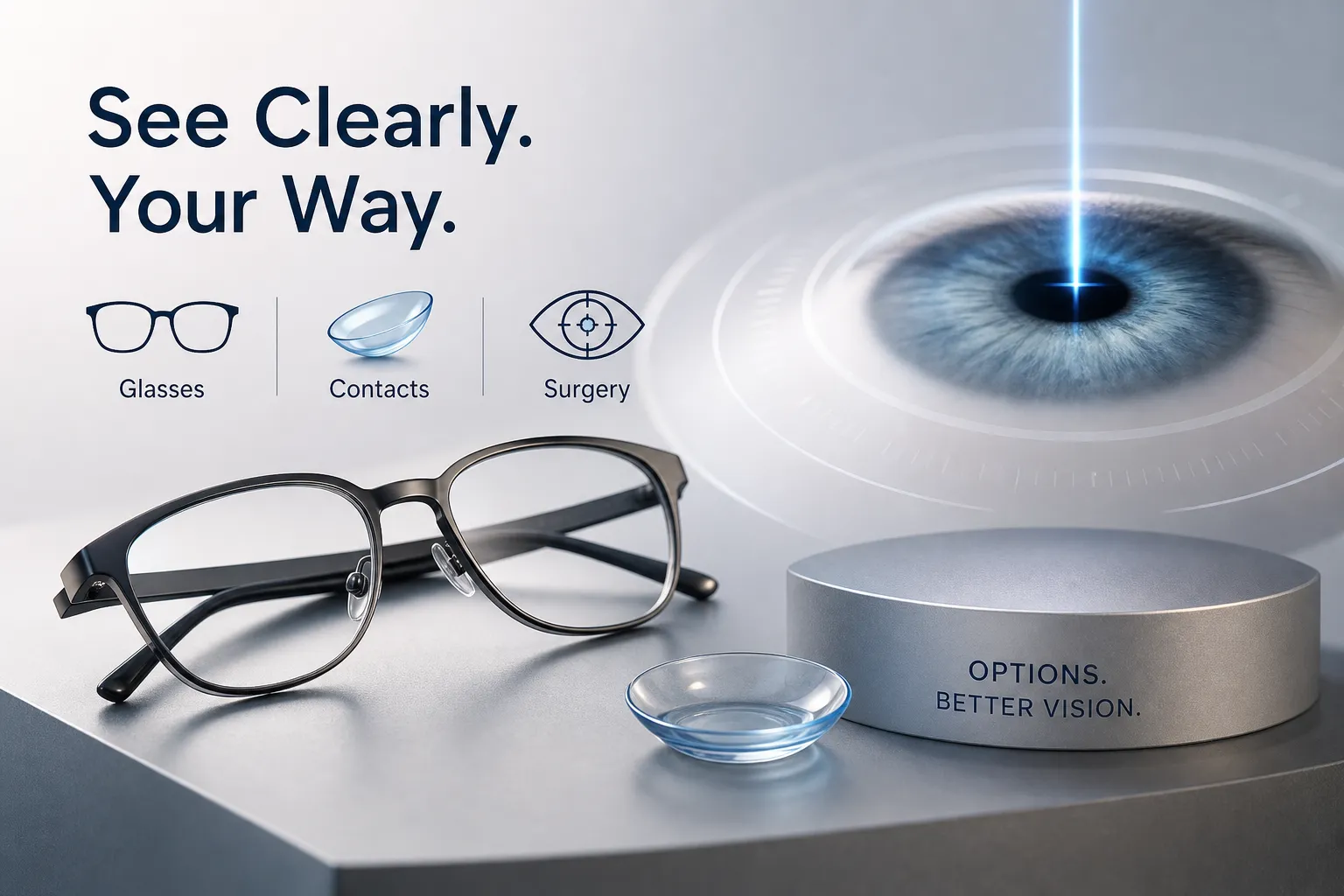
The good news is that astigmatism correction offers far more options than most patients realise, and they are more navigable than the jargon suggests. Cylindrical spectacle lenses, soft toric contacts, rigid gas-permeable lenses, scleral lenses, laser surgery, and toric intraocular implants all exist on the same spectrum, each suited to a different severity level and lifestyle. This guide maps that spectrum clearly, so your next appointment becomes a conversation rather than a lecture you are trying to follow in a foreign language.
What your astigmatism prescription actually tells you
Decoding cylinder and axis values on your script
Your eyeglass prescription is written in a format that looks like this: SPH / CYL × AXIS. The SPH (sphere) value corrects your short- or long-sightedness. The CYL (cylinder) value, measured in dioptres, tells you how much astigmatic correction your eyes require. The AXIS, expressed as an angle between 1 and 180 degrees, tells the lens laboratory precisely where to position that correction on the lens so it lines up with the orientation of your cornea’s uneven curvature.
One thing worth understanding immediately: over-the-counter reading glasses carry no cylindrical power at all. They are spherical lenses. No matter how strong they are, they cannot address astigmatism, which is why people with uncorrected astigmatism often find cheap readers make things worse rather than better.
How severity determines your correction pathway
Astigmatism does not operate as a single fixed problem with a single fixed answer. Severity matters enormously. A useful mental model is to think in four tiers:
- Low (0.75, 1.00 D): symptomatic correction usually needed; most options are available.
- Moderate (1.25, 2.25 D): glasses or standard toric soft lenses; refractive surgery for astigmatism is highly effective.
- High (2.50, 4.00 D): custom-made lenses are likely; rigid or scleral lenses become clinically relevant.
- Extreme (above 4.00 D): custom-fabricated correction is essential; surgical options are more complex.
Knowing where your own CYL value sits in these tiers will make each section below far more personal and practical.
Corrective lenses for astigmatism: glasses with cylindrical lenses
Cylindrical lenses work by adding refractive power along one meridian only, steering two displaced focal lines back into a single sharp point on the retina. Unlike a standard spherical lens, a cylindrical lens must be placed at the exact axis dictated by your prescription. Even a few degrees of misalignment introduces blur, which is why precise dispensing matters as much as the prescription itself.
Modern high-index and aspheric lens technology has made strong cylindrical corrections thinner, lighter, and more comfortable to wear than older designs. Glasses are effective corrective lenses for astigmatism across every severity level, require no adaptation period, and carry no risk of the lens rotating mid-day and blurring your vision at a critical moment. They remain the preferred first-line option for children and for anyone who finds contact lens maintenance more burden than benefit. For patients with irregular corneas, however, it is worth noting that speciality contact lenses such as rigid gas-permeable or scleral lenses often deliver sharper vision than spectacles alone. If you’re deciding between soft and rigid options, our guide to the differences between soft and hard contact lenses can help clarify the trade-offs. For extreme prescriptions above 4.00 D CYL, custom-ordered lenses are sometimes required in South Africa, which can extend lead times, so factor this into your timeline.
Toric contact lenses and speciality lens options
Soft toric lenses: comfortable correction with an important caveat
Soft toric lenses carry different optical powers in different meridians and use weighted or ballasted zones to maintain their orientation on the eye. They are the go-to choice for active wearers with low-to-moderate astigmatism. Astigmatism contact lens fitting for soft torics is typically suited to prescriptions up to around 2.50 D CYL, and adaptation is quick, most wearers are comfortable within a day or two, with day-long comfort noticeably better than rigid alternatives.
The important caveat: the lens can rotate slightly with blinking, and because axis alignment is everything in astigmatism correction, even a small shift introduces blur. Fitting a soft toric lens is also more involved than fitting a standard spherical contact lens. Not every cylinder-and-axis combination is available off the shelf. Professional expertise and follow-up visits to confirm rotational stability are not optional extras; they are part of the process. New wearers may find practical, everyday advice useful, see our top tips for new contact lens wearers for guidance on adaptation and care.
RGP and scleral lenses: precision for irregular or high astigmatism
Rigid gas-permeable lenses maintain their shape on the eye and effectively neutralise corneal irregularities, which is why they consistently deliver sharper optics than soft toric alternatives in head-to-head comparisons. They suit patients with high astigmatism above 2.50 D CYL, irregular corneas, or conditions like keratoconus. Scleral lenses, which vault the cornea entirely and rest on the scleral tissue, go a step further for the most complex presentations.
The trade-off is real: RGP lenses typically require one to three weeks of daily wear before the eye adapts fully, and the fitting process is considerably more involved than for soft lenses. The outcome depends as much on the expertise doing the fitting and the technology mapping your cornea as it does on the lens itself.
When refractive surgery or toric IOLs enter the picture
LASIK and related corneal refractive procedures reshape the cornea to permanently reduce or eliminate astigmatism. Refractive surgery for astigmatism is most effective for mild-to-moderate cases below 2.50 D CYL, and eligibility hinges on corneal thickness and overall eye health. Custom wavefront-guided treatments extend the range, but the conversation about surgery belongs with an ophthalmologist. A thorough optometric assessment is typically the first step toward establishing candidacy. In South Africa, costs can range from around R3,500 for an initial assessment to between R18,000 and R40,000 or more for both eyes, depending on the clinic and technology used.
Toric intraocular lenses take a different route entirely. Rather than reshaping the cornea, a toric IOL is implanted during cataract surgery to correct astigmatism at the same time the cloudy natural lens is removed. Clinical outcomes data indicates that 80 to 94 per cent of eyes achieve less than 0.50 D of residual astigmatism post-operatively, and most patients experience a meaningful reduction in spectacle dependence. The primary risk is lens rotation after implantation: every degree of misalignment reduces correction efficiency by approximately 3.3%, making precise pre-surgical measurement non-negotiable.
Getting the right fit starts with the right diagnosis
Accurate astigmatism correction, whether in glasses, toric contacts, or surgical planning, is only as good as the measurement behind it. Standard autorefraction estimates refractive error from the centre of the cornea. Corneal topography maps the curvature of the entire corneal surface, revealing the steep and flat meridians with a level of precision that changes clinical decisions. It is the difference between having a general sense of the terrain and holding a detailed survey map of it.
At EyeQ Optometrists, advanced diagnostic and ocular imaging technology is available across all four Cape Town locations. That precision matters most for astigmatism contact lens fitting, where axis accuracy directly determines visual clarity, and for identifying irregular astigmatism patterns that would be missed on a standard refraction. Before committing to any correction type, consider asking your optometrist these questions: Does my CYL value make me a candidate for all options, or does severity rule any out? Based on my corneal shape, am I better suited to soft toric or RGP lenses? Would corneal topography change my prescription compared to a standard refraction? What follow-up visits are needed to confirm lens stability?
The right lens is a decision worth making carefully
The right choice hinges on how severe your astigmatism is, what your lifestyle demands, and how thorough the diagnostic work-up behind your prescription has been. Those three factors together, not any single one in isolation, determine which corrective lenses for astigmatism will actually serve you well over time.
If you are in Cape Town and ready to explore your options with proper technology and clinical expertise behind you, book a comprehensive eye examination at EyeQ Optometrists. That single appointment is where clear vision starts.