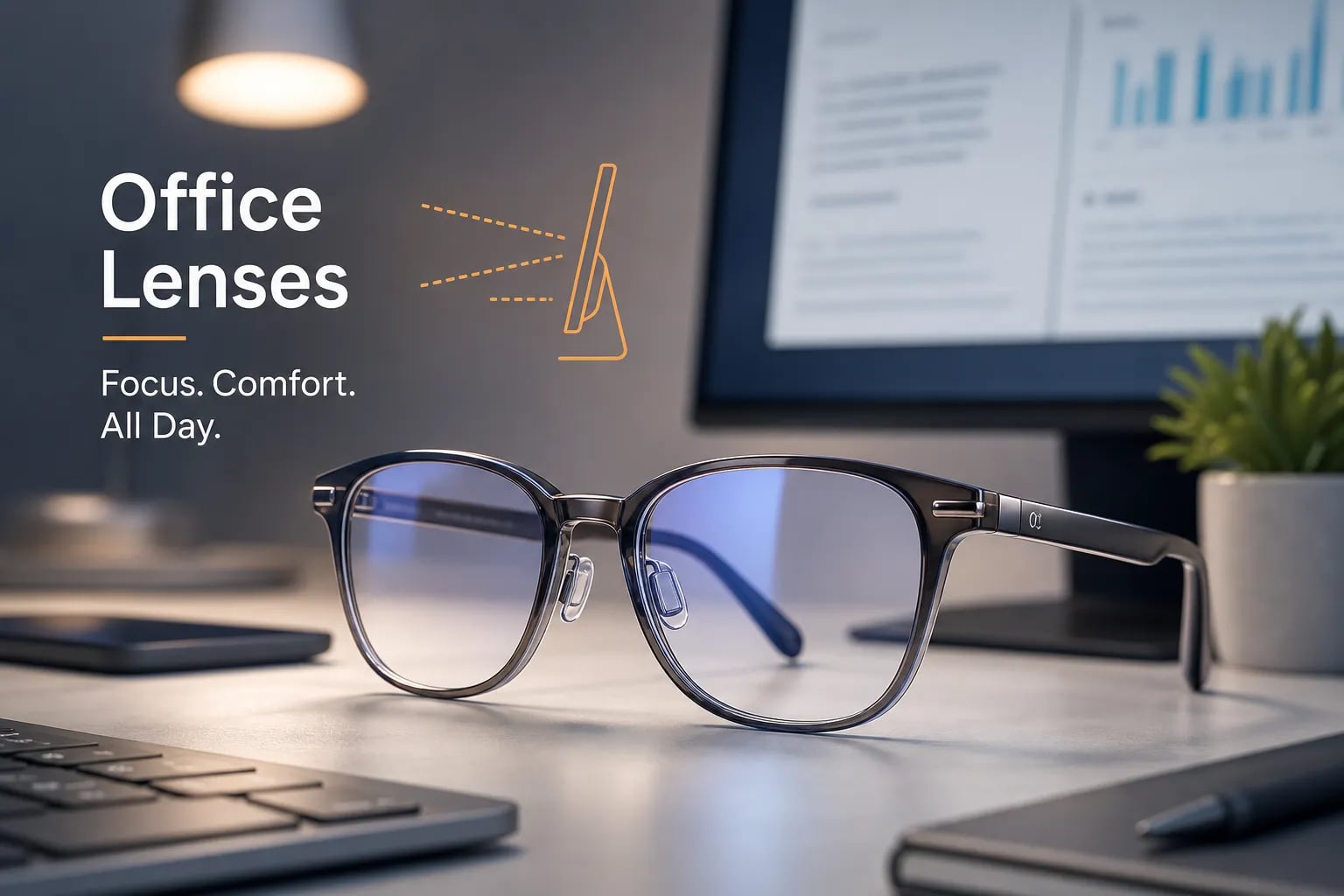
Office lenses are purpose-built for the distances you use at a desk, and for many people who spend the bulk of their working day in front of a screen, they make a measurable difference. Picture a desk worker at 3 p.m., head tilted backward, hunting for that narrow corridor at the bottom of their progressive lenses just to read a spreadsheet. Or the person who removes their glasses entirely every time they turn to their monitor, then puts them back on to see across the room. These habits feel like minor inconveniences, but they point to something more fundamental: a design mismatch. Standard progressive lenses are designed for all-day wear, covering distance, intermediate, and near vision for general life. Your workday, however, has its own visual demands, and standard lenses are not necessarily optimised for them.
This is where occupational lenses come in, a category most desk workers have never been told about. Sometimes called computer lenses or indoor lenses, they are purpose-built for the distances between you and your screen, your keyboard, and your nearby colleagues. At a well-equipped optometry practice, specialised fittings go beyond your prescription alone: the lens design is matched to your actual workspace, including monitor placement and typical head position.
What office lenses actually do differently
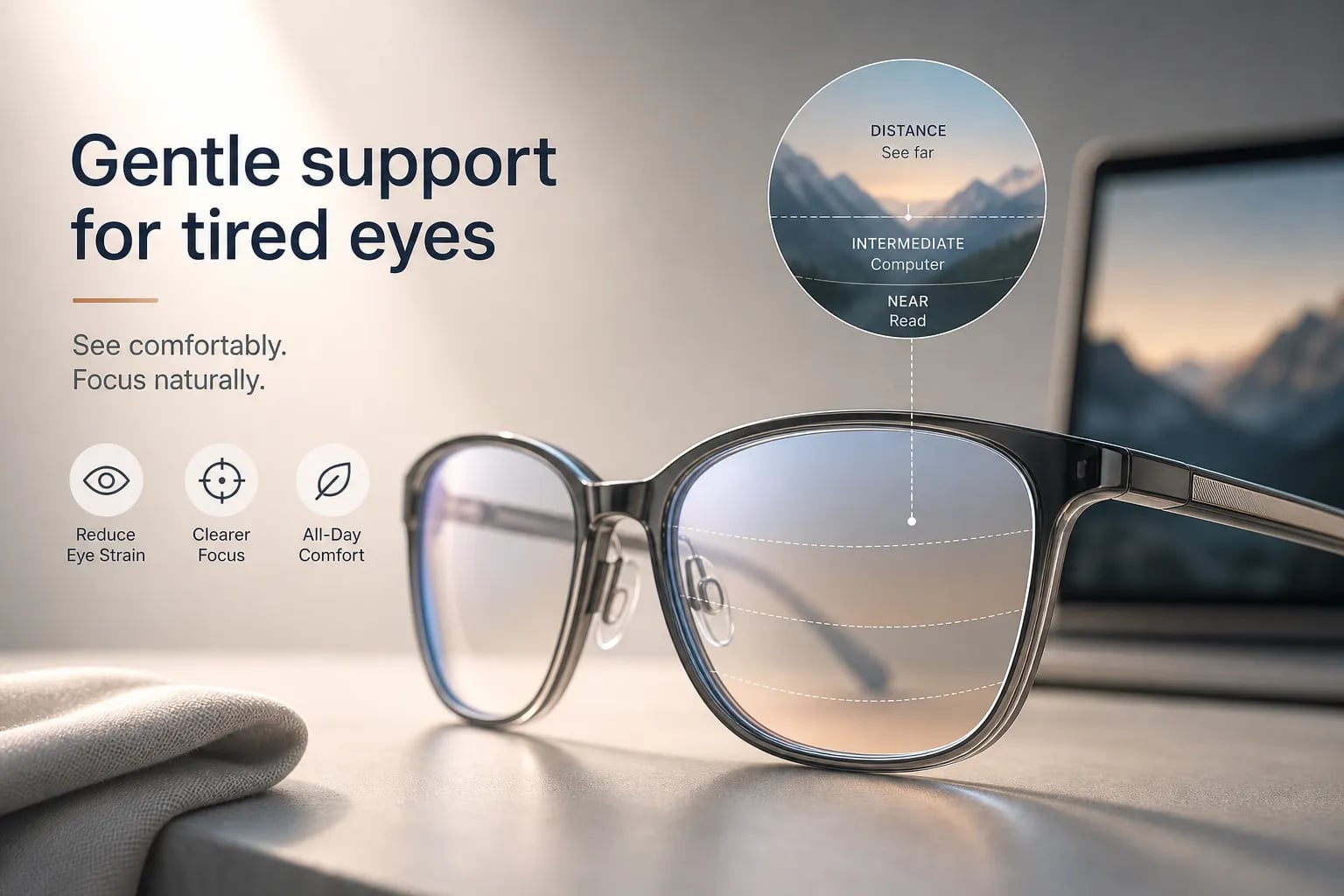
The core design principle is a deliberate trade-off. Office lenses give up distance vision in exchange for a significantly wider clear zone across near and intermediate distances. Where a standard progressive divides the lens surface across three ranges, far, mid, and near, an office lens dedicates almost all of that real estate to the distances a desk worker actually uses: roughly from reading distance out to the far side of a meeting table.
The intermediate zone that other lenses miss
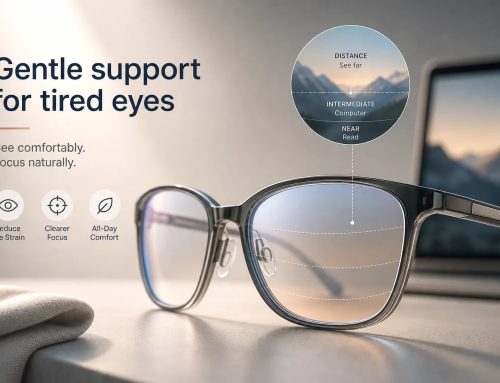
The intermediate viewing distance, broadly the range from around 50 to 120 centimeters, where your monitor, keyboard, second screen, and nearby colleague all live, is where standard lenses tend to fall short. Reading spectacles cover one fixed close distance and blur immediately beyond it. Standard progressives cover this zone, but through a narrow corridor that forces a specific head position to use comfortably. Office lenses widen this intermediate zone considerably, and that single design difference is what makes them worth understanding for anyone who spends the majority of their day at a desk.
Reading glasses, progressives, and office lenses compared
Think of this as a tool selection problem rather than a “which is better” debate. Reading glasses correct one fixed close distance only; the moment you glance toward a monitor, clarity disappears. Standard progressive lenses cover far, mid, and near in one lens, which makes them excellent for general daily use, but the intermediate zone is narrower than most desk workers need, and they are optimised for life in motion, not sustained close work. Office lenses narrow the focus to near and intermediate only, giving a wider and more comfortable viewing area for desk tasks. The trade-off is straightforward: you cannot drive or walk around comfortably in them. They are a second pair, not a replacement for your everyday lenses.
Why desk workers feel the strain with standard lenses
Many people assume that end-of-day eye fatigue, tension headaches, or a stiff neck are simply the cost of too much screen time. Often, the lens design is amplifying the problem. Using a lens that was never optimised for desk distances for eight or more hours a day has real physical consequences that accumulate quietly over time.
The posture and eye strain connection
Standard progressive lenses force a desk worker to tilt their head backward or forward to find the narrow intermediate corridor, placing sustained tension on the neck and upper back. Occupational lenses are designed with the natural head position at a desk in mind, reducing that constant postural adjustment. Optometric and manufacturer guidance identifies office/intermediate specific lenses as a tool for relieving symptoms associated with computer vision syndrome: eye fatigue, blurred vision at intermediate distances, and neck tension from postural compensation. It is worth noting that for those wearers whose primary complaint is intermediate-zone discomfort, the wider viewing field makes a tangible practical difference.
When your current lenses are working against you
The tell-tale signs are specific. You read through the bottom of your progressives. You remove your glasses to see the screen more comfortably. You lean toward the monitor to bring it into focus. You feel persistent tiredness in your eyes by the end of the working day. These are not signs of worsening eyesight; they are signs of a lens designed for one context being used heavily in another. If several of these apply to you, a consultation about task-specific spectacles is worth having.
Brands and options available in South Africa
South Africa has access to the main global occupational lens portfolios. The right brand depends less on reputation than on your specific working distance and workspace layout, and a good specialist practice will walk you through the options rather than defaulting to a single product.
ZEISS Office lenses offer a well-segmented range, with distinct designs labelled by working distance: Book (clear vision out to approximately 50 centimeters), Near (out to 2 meters), Room (out to 4 meters), and a fully customised Individual option. This structure suits wearers with a very specific workspace layout.
HOYA’s WorkStyle portfolio takes a similar tiered approach, Space, Screen, and Close variants, with a strong emphasis on wide intermediate and near zones, positioned as a complement to your regular progressives rather than a standalone solution.
These are available through EyeQ Optometrist. The brand ultimately matters less than getting the office lens design matched correctly to your working distance.
Coatings that make a real difference at a desk
An anti-reflective coating is close to essential for screen use, cutting reflections from monitors and overhead lighting that would otherwise compete with the lens optics. Blue-filter coatings are often added for prolonged screen work. High-index thinning becomes relevant for stronger prescriptions. These additional features could be discussed with your optometrist during the fitting
How a proper office lens fitting works
An occupational lens is not simply dispensed from a prescription. The fitting requires additional measurements specific to how and where you work, and the quality of that process determines how well the lens actually performs in your particular workspace.
What your optometrist measures and why it matters
The key measurements include your working distance (how far your eyes sit from the monitor and reading surface), monitor height relative to eye level, near reading distance, pupillary distance for each eye separate, and frame fitting height. These measurements determine the add power of the lens and where the different viewing zones are positioned within the frame.
The right lens for the right context
There is a quiet irony at play here. Desk workers are among the heaviest daily users of near and intermediate vision, yet they are routinely using lenses optimised for distance, driving, and general life. Office lenses are not a niche product for a rare condition: they are a logical match for anyone who spends most of their working day between a screen and a page.
Ask yourself three questions: how much of your day is desk-based, whether your current lenses are causing postural or visual discomfort, and whether you need distance vision in the same pair. If your answers point toward task-specific spectacles, the best next step is a proper consultation with an optometrist who can assess your workspace alongside your prescription. If office lenses sound like they could help, book an appointment at EyeQ Optometrists, with locations at Canal Walk, Cavendish Square, Tygervalley, and the V&A Waterfront in Cape Town. EyeQ Optometrists offers exactly that kind of expert, context-specific fitting.