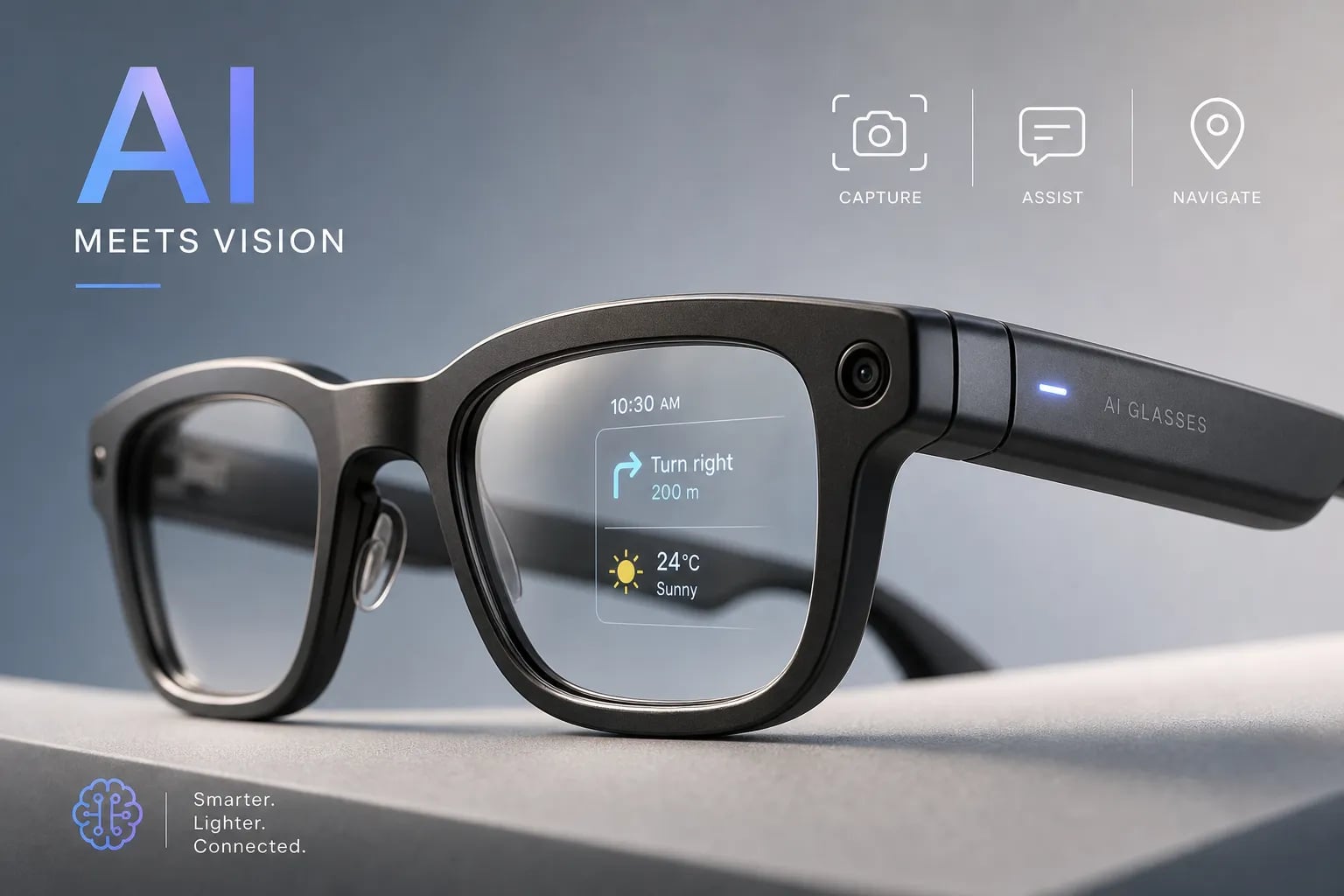
Spectacles have been used for vision correction for centuries. For most of that time, a pair of frames sitting on your nose meant one thing: corrected vision. Now, some smart glasses, such as the Ray-Ban Meta Gen 3, contain a six-microphone array, an AI language model, a camera, and a real-time translation engine. AI and smart glasses have arrived at a genuinely fascinating intersection, where the ordinary and the extraordinary meet on the bridge of your nose.
At EyeQ Optometrists, we work at the intersection of clinical technology and eye care. Advanced ocular imaging, digital retinal scanning, and precision diagnostic tools form part of the comprehensive eye examinations we offer. So when patients ask us about AI-powered smart glasses, the question doesn’t feel like a leap, it feels like the next logical step. What follows is an honest look at what these devices actually do, where the health angle gets genuinely interesting, what South African law says about wearing them, and which models you can buy locally right now.
What AI inside your glasses actually does today
The most mature capability in current AI and smart glasses is real-time audio intelligence. The Ray-Ban Meta Gen 3 is the clearest example: a six-microphone array captures ambient conversation while Meta AI processes it through open-ear speakers, delivering live translation of spoken language. According to Meta, on-device processing can achieve sub-100ms latency for supported languages. Cloud-dependent translation adds roughly 200 to 800 milliseconds, a gap that feels significant when you’re mid-conversation with someone speaking Mandarin or Portuguese. For live conversation, on-device processing isn’t just faster; it closes the gap between a useful tool and a party trick.
Beyond translation, augmented reality (AR) overlays are becoming practical. Some models deliver directional cues, object recognition, and contextual labels through a small embedded display; others route everything through audio alone. The Meta Ray-Ban Display variant introduces a visible screen overlay that places it among the more AR-capable options at a consumer price point, though “true AR” remains a moving target as the category evolves. Processing is typically hybrid: local rendering handles immediate overlays, while cloud calls manage heavier scene understanding, such as identifying a product in a supermarket or reading signage in an unfamiliar city.
AI and smart glasses for health monitoring: where it gets genuinely interesting
The lifestyle features attract attention, but the health angle is where wearable AI glasses start to matter in a different way. Some current frames and near-future prototypes incorporate PPG sensors (a non-invasive optical device that measures changes in blood volume under the skin) for heart rate and blood oxygen monitoring, Inertial measurement units (IMUs) is an electronic device that measures and reports a body’s specific force, angular rate and sometimes orientation in 3D space. These are used for posture and motion tracking, and optical sensors for eye movement analysis. Blink-rate monitoring is particularly relevant: research suggests reduced blink frequency can be an indicator of digital eye strain. On-device health processing keeps biometric data local, which is both a performance and a privacy advantage.
The accessibility use case is equally compelling. Real-time scene description, obstacle detection, and text-to-audio conversion are already available on several AI glasses platforms, giving people with low vision meaningful independence in daily navigation. This is not speculative. These assistive applications represent one of the strongest arguments for why AI eyewear is more than a gadget category, the technology already has meaningful real-world impact for users who rely on it.
AI and smart glasses: on-device processing vs cloud, the trade-off that shapes your experience
Features that need to feel instant are best handled on-device, where latency sits in the tens of milliseconds. Cloud processing introduces network round-trips that, depending on connection quality, can range from around 200ms to well over a second. In South Africa, where 4G long term evolution (LTE) coverage varies considerably outside urban centres, offline capability is a practical buying consideration, not just a spec-sheet detail.
The privacy dimension follows directly from this. Cloud-dependent features send voice prompts, camera frames, and biometric data to third-party servers for processing. On-device AI keeps personal data local. If you’re evaluating a purchase, asking “which features require a network connection?” is one of the most useful questions you can put to a retailer before committing.
Wearing camera glasses in South Africa: what the law actually says
South African law has no smart-glasses-specific statute, but POPIA and constitutional privacy rights apply whenever identifiable personal information, including images, voices, or biometric data, is captured, stored, or shared outside a purely personal context. Recording casually in a public space for personal use carries the lowest legal risk. Sharing, analysing, or storing footage of identifiable individuals in a commercial or work context triggers compliance obligations under POPIA.
Biometric data, including facial features and voice-prints, is classified as special personal information under POPIA, requiring a lawful processing basis. A useful rule of thumb for everyday wear looks like this:
- Personal recording in public spaces: lowest legal risk, especially if footage is not stored or shared.
- Recording in commercial or workplace settings: requires notice, a clear policy, and in some cases explicit consent.
- Capturing or transmitting biometric data to third-party platforms: treat with the same caution as any sensitive personal information under POPIA.
Your next eye exam is the right starting point
The humble pair of glasses is becoming the most personal AI device that many people will ever own. The shift isn’t only about convenience, it’s about how we interact with language, space, health data, and the visual world itself. As AI and smart glasses move from novelty to everyday utility, optometry and technology are converging in ways that have real clinical significance.
EyeQ Optometrists is built on advanced diagnostic capability, precision prescribing, and a thorough understanding of how vision works, which places our team at the centre of that evolution. Before choosing a wearable AI glasses platform, the most useful step you can take is understanding exactly what your vision needs. A concrete starting point: book a comprehensive eye examination with our team, and let that clinical clarity guide the decision.