You’ve been working at your laptop for two hours, and your eyes feel like they’re wrapped in wet cotton. You blink, look away, blink again. Nothing helps. Most people blame the screen, the lighting, or simply getting older. The real explanation is often more specific than that, and it has a clinical name: accommodative strain. Understanding whether you need accommodative support is the first step towards getting the right solution, rather than reaching for a quick fix that doesn’t address the actual problem.
Your eye contains a tiny focusing muscle called the ciliary muscle, which continuously contracts and relaxes to shift focus between distances. This process is called accommodation, and it is active and metabolically demanding. Think of holding a half-kilogram weight at arm’s length, harmless for a few minutes, genuinely exhausting after two hours. That analogy captures something real about sustained near work, even if the physiological mechanisms differ. For adults in their late 30s and early 40s, accommodation becomes measurably less efficient, even before the word “presbyopia” enters the conversation. This article explains what accommodative support lenses are, what the evidence says about them, who genuinely benefits, and what to ask at your next visual examination.
What “accommodative support” actually means in optometry
Accommodation is the eye’s ability to change focus by altering the shape of the crystalline lens through the working of the ciliary muscle. When you read or work at a screen, this muscle holds continuous tension to keep near objects sharp. In many people, the eye doesn’t fully achieve the focus it’s aiming for, leaving a small residual blur at the near point. The brain compensates for this accommodative lag, but that compensation carries a cost: fatigue, headaches, and that heavy, unfocused feeling after sustained near work.
There is an important distinction worth understanding here. Accommodative insufficiency refers to a focusing system that underperforms relative to what’s expected for a patient’s age; it can affect younger adults and even children. Presbyopia, by contrast, is the age-related stiffening of the crystalline lens that begins to limit near focus from around 40 onwards. Adults in their late 30s often sit between these two states, not yet presbyopic by clinical definition, but with a reduced accommodative reserve that makes sustained near tasks increasingly uncomfortable. Accommodative support lenses are designed precisely for this gap.
How near-vision support lenses work, and what the research actually found
The optics explained
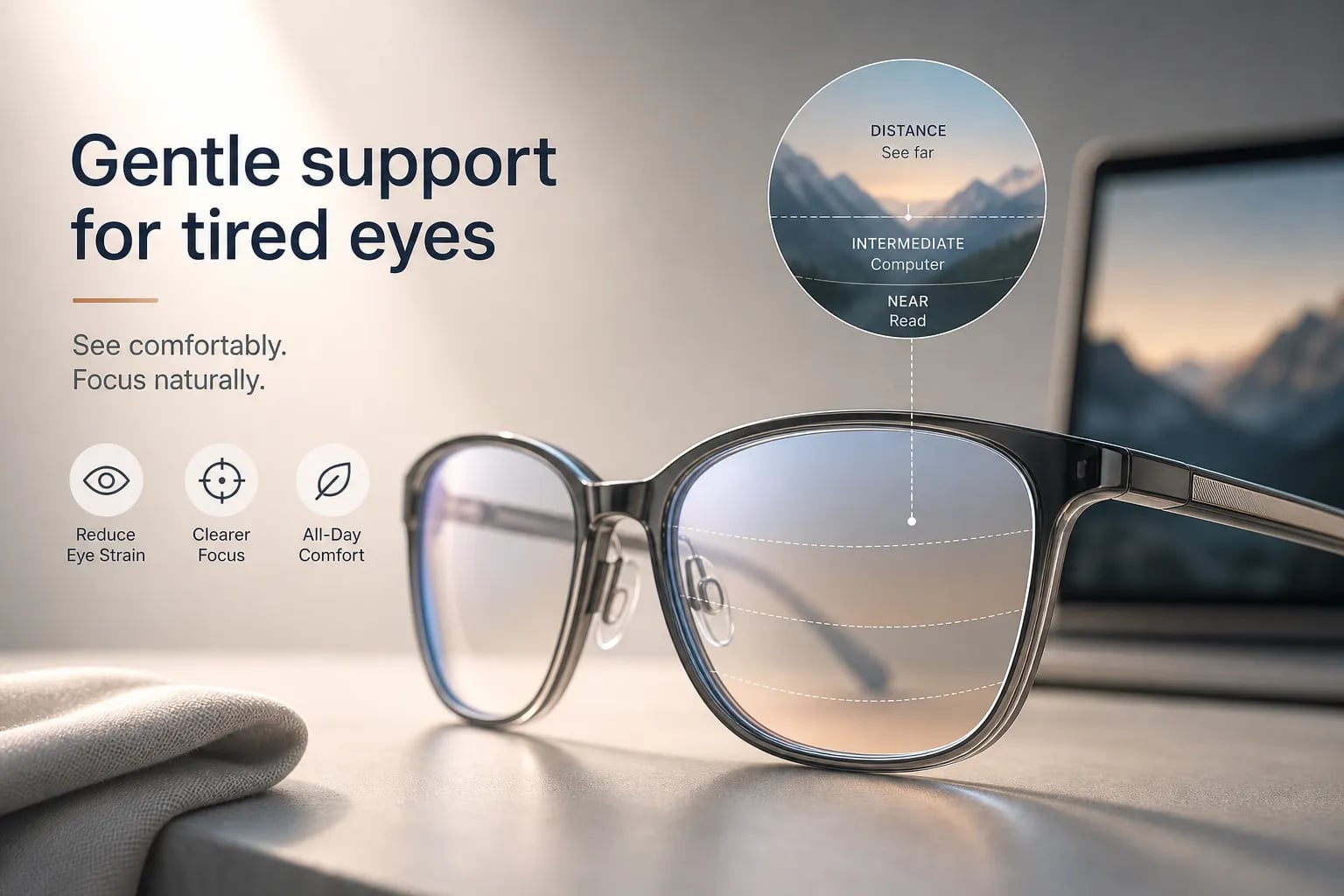
Accommodative support lenses, sometimes called anti-fatigue lenses or low-add single-vision lenses, incorporate a mild plus-power boost in the lower portion of the lens. The upper zone retains the full distance prescription, while the lower zone typically adds between +0.50 D and +1.25 D to reduce how hard the ciliary muscle has to work during near tasks. This is not the same as a reading lens (which provides a single near-only correction) or a progressive lens (which carries a full graduated corridor of power from distance through to near). It is also entirely different from an anti-reflective or blue-light coating, which is a surface treatment with no effect on optical power.
What the clinical evidence shows
A clinical trial published in 2021/2022 found that the lenses were well tolerated, showed no adverse effects on binocular or accommodative function, and were more likely to be preferred by participants over single-vision lenses after a short one-week trial period.
Who benefits from accommodative support lenses
The strongest candidates
The strongest candidates are pre-presbyopic adults in their late 30s and early 40s with measurable accommodative lag or insufficiency, particularly those who spend prolonged hours daily on screens and who notice symptoms specifically during and after near work, not at distance. Children with diagnosed accommodative insufficiency also form a recognised candidate group, where the evidence for targeted intervention is generally considered stronger than for adult populations. Post-concussion patients sometimes benefit as well, when their symptoms reflect accommodative or vergence deficits specifically.
What these lenses won’t fix
Dry eye disease accounts for a significant portion of screen-related eye discomfort, and accommodative support lenses will not address it. They also won’t resolve convergence insufficiency or the effects of poor ergonomics. Assuming that all near-work fatigue has the same accommodative origin is the wrong starting point. The correct starting point is a proper diagnostic assessment that distinguishes between these causes.
What about ready made reading glasses
Off-the-shelf reading glasses provide a fixed near correction with no relationship to your actual prescription, accommodative function or working distance, and they can worsen symptoms if the power is poorly matched. What looks like a convenient shortcut can, in practice, deepen the problem.
At EyeQ Optometrists, across their four Cape Town locations at Canal Walk, Cavendish Square, Tygervalley, and the V&A Waterfront, assessments go well beyond a mere prescription check. Their clinical approach evaluates the visual system, that determines whether a lens prescription actually addresses the problem rather than simply providing a lens.
When you next visit your optometrist, bring the question: Would a low-add design be appropriate, or is another solution better suited to what you’re finding?
The lens only helps when the diagnosis is right
Think back to that spreadsheet and the wet-cotton feeling in your eyes. What you were experiencing has a specific mechanism: a focusing system under sustained strain, asked to perform beyond its comfortable limits without relief. Accommodative support is not a marketing term. It describes a real optical and physiological concept, backed by clinical measurement and research.
Whether these lenses are the right solution for you depends entirely on the underlying issue. If near-work fatigue is affecting your daily visual comfort, an eye examination that evaluates your accommodative function is the logical next step. A conversation with a qualified optometrist who can assess the full picture is what will determine whether accommodative support lenses are genuinely appropriate for you. EyeQ Optometrists offers that kind of comprehensive assessment across their Cape Town practices, making it a sensible place to start that conversation.