If you have been holding menus, phone screens, or medicine labels just slightly further away than you used to, you may already be experiencing the earliest signs of presbyopia. Choosing the right glasses for early presbyopia at this stage, rather than reaching for the nearest pair of pharmacy readers, can make a meaningful difference to how clearly and comfortably you see in the months and years ahead. At EyeQ Optometrists, we often see patients arrive at our Cape Town practices wearing a particular expression: slightly puzzled, half-convinced something is wrong. Nothing is wrong. But the choices you make in these early months shape your vision for years to come.
What early presbyopia actually feels like
The first signs most people shrug off
The symptoms are easy to dismiss at first. Small print becomes harder to read, especially in dim light. Your phone screen, a receipt, or labels needs a little more distance before it resolves into focus. Mild eye strain follows reading sessions, and occasionally a dull headache surfaces after sustained close work. These early presbyopia symptoms typically appear somewhere between the ages of 40 and 45 in most adults, often beginning quietly enough that most people attribute them to tiredness rather than a genuine change in their vision.
Why your near vision is changing, and what that means
The lens inside your eye is gradually losing the elasticity it once had to shift focus between distances. This is not a disease, and it is not a sign of premature decline. Every adult, without exception, goes through this process. The most useful way to think about it: presbyopia is a transition, not deterioration. Shifting your perspective this way removes the anxiety and redirects attention to the only question worth asking, which is how to correct it well.
Ready made reading glasses for early presbyopia vs prescription lenses: the honest trade-off
When ready made readers actually make sense
Over-the-counter ready made reading glasses may be a legitimate starting point for some people. They work reasonably well when both eyes need roughly the same near correction, when there is no meaningful astigmatism, and when near tasks are occasional rather than sustained. In South Africa, you will find them at pharmacies, novelty stores, some supermarkets and Optometry practices. For light, infrequent reading, they could be a reasonable short term solution.
Where they fall short for daily life
The limitations emerge the moment your visual needs become more specific. Ready made readers use the same power in both lenses, they do not correct astigmatism, and they are manufactured to an assumed average pupillary distance that may not match yours. If your eyes differ even slightly in their near-vision needs, or if you work at a screen for most of the day, ready made readers will likely leave you straining during prolonged use. That eye strain is the predictable result of optics that approximate rather than match your prescription.
Glasses for early presbyopia: lens options worth knowing
Single-vision reading lenses and starting add powers
Prescription single-vision reading lenses are the most direct step up from ready made readers. They are made to the exact correction each eye requires, they account for astigmatism, and they are centred to your pupillary distance. For early presbyopia, the typical starting add power falls between +0.75 and +1.50, with lower adds of +0.75 to +1.00 being common in the early 40s. These figures are not estimates: a full near-vision assessment determines the right add for each eye and for your actual working distance, whether that is a book on your lap, a tablet, or a monitor at desk height.
Office lenses, mild progressives, and accommodative support lenses
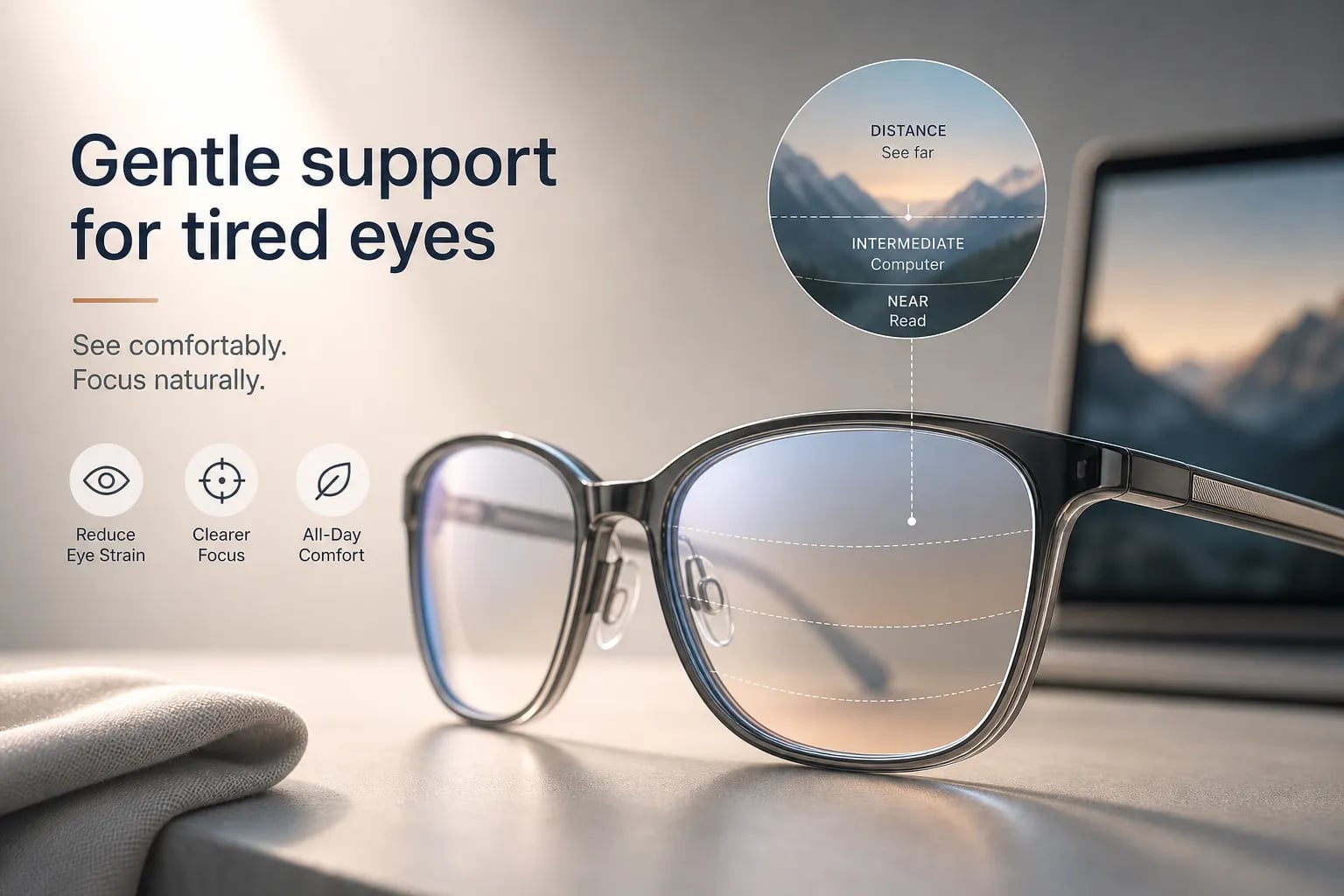
Adults who need near and intermediate vision covered in a single pair have several options. Office lenses, sometimes called occupational lenses, are optimised for desk and screen distances and offer a wider intermediate zone than standard progressives or bifocals. They suit sustained computer work well. Because they are not designed for distance viewing, a separate pair is needed for driving.
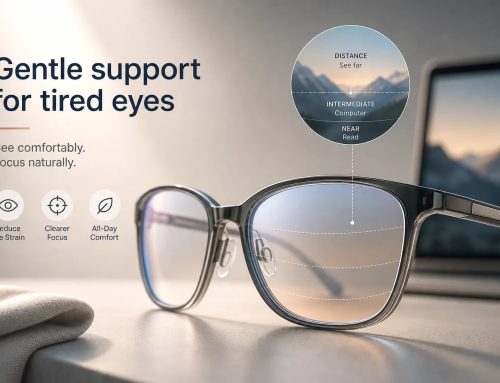
Mild progressive lenses provide a gradual, seamless shift from distance through intermediate to near, making them the more versatile everyday option for those seeking the best glasses for early presbyopia in an active lifestyle. Accommodative support lenses sit at the gentler end of the spectrum, offering a small boost for close tasks that may ease near-vision strain in the very earliest stages.
Matching the right lens to your daily routine is where a thorough assessment earns its value.
Why getting the right prescription early matters
What a thorough presbyopia assessment actually involves
A professional near-vision assessment does several things a ready reader trial simply cannot. It measures visual acuity for each eye separately, evaluates remaining accommodation, determines the appropriate add power, checks for astigmatism, and accounts for your preferred working distances. Getting the add power wrong by even 0.25 D can produce prolonged eye strain or a prescription that demands constant effort to use comfortably. These details only emerge from a full clinical assessment, and they directly affect how comfortable the final lenses feel from day one.
How EyeQ Optometrists approaches early presbyopia
At EyeQ Optometrists, our practices at Canal Walk, Cavendish Square, Tygervalley, and the V&A Waterfront are equipped to assess near-vision changes at their earliest stage, before a patient has spent months compensating with the wrong correction. Identifying early presbyopia accurately means a prescription calibrated correctly from the start: less adaptation time, better comfort, and lenses that genuinely match your daily demands. Whether you spend your day behind a screen or moving between tasks across the city, an examination at EyeQ gives you a correction built for your life rather than a generic approximation of it.
Start with clarity, not guesswork
Early presbyopia is not a crisis. It is a signal, and the right response is a clear, informed decision rather than months of straining through readers that do not quite work. The right reading glasses for presbyopia, fitted to an accurate prescription, make a measurable difference to how you read, work, and move through your day.
As a practical guide: ready made readers suit occasional, uncomplicated near tasks reasonably well; prescription single-vision or mild progressive lenses are the stronger choice for daily life and sustained close work; and a comprehensive eye examination is the logical first step when you want to get your glasses for early presbyopia right from the outset. If you have been noticing any of the signs discussed here, booking an eye test is the clearest next step. At EyeQ Optometrists, we see this transition every day. Book an eye test at any of our EyeQ branches and let us help you navigate it with confidence.