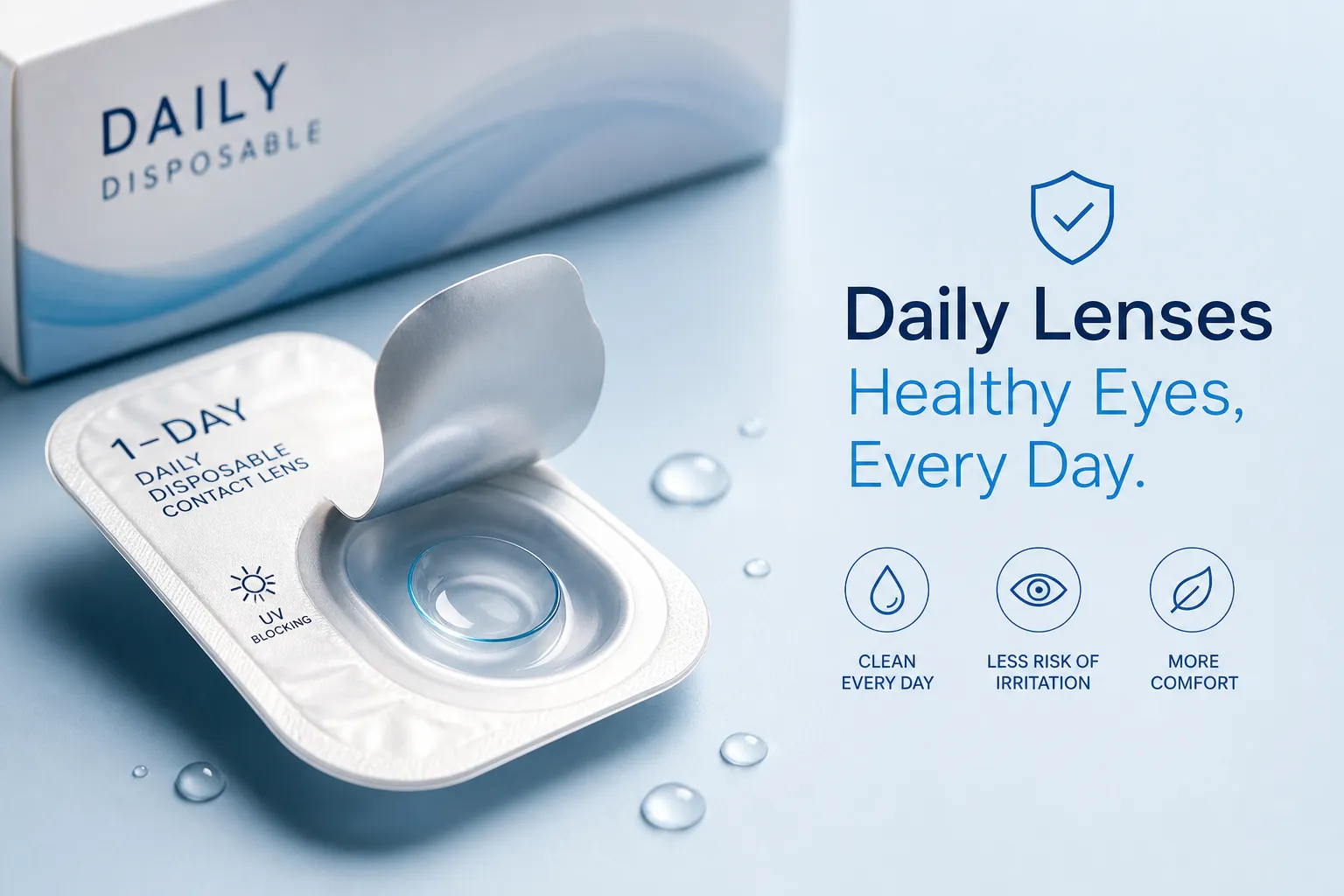
There is a deeply satisfying ritual to cleaning your contact lenses each evening. It feels responsible, the kind of disciplined habit a health-conscious person maintains. But the science behind what actually accumulates on a reusable lens between Monday and month-end tells a far more complicated story than the routine suggests. This article explores the health benefits of daily contact lenses and why a growing number of wearers and clinicians are choosing them over reusable alternatives.
The central insight is this: single-use, daily disposable contact lenses reduce several of the most common pathways to eye infection and irritation, not because the materials are dramatically superior, but because the lens is discarded before the problem begins. At EyeQ Optometrists, this is one of the most common conversations our practitioners have with patients who arrive thinking they are doing everything right, but who are quietly suffering from recurring redness, dryness, or irritation.
Health benefits of daily contact lenses: reduced infection risk
The element most reusable lens wearers never think about is the lens case. Clinical literature consistently identifies the storage case as a primary source of contamination, and the mechanism is straightforward: biofilm forms in storage cases even when wearers follow the instructions on the packaging. Bacteria survive imperfect disinfection cycles and transfer directly to the lens, and from there, to the eye.
Reusable lenses do not fail wearers on their own. The hygiene chain around them does. A review published in the journal Ophthalmology found that reusable lenses carry roughly four times the risk of rare but sight-threatening infections such as Acanthamoeba keratitis, compared to daily disposable lenses. The British Contact Lens Association (BCLA) and the College of Optometrists both cite single-use lenses as the lowest adverse-event modality available, precisely because eliminating the case eliminates one of the most persistent vectors for contamination.
The picture with corneal infiltrative events (CIEs) – EXPLAIN and acute red eye episodes is equally clear. Daily disposable wearers show significantly lower rates of these complications, driven largely by better replacement compliance and the complete absence of case hygiene risks. The lens is opened, worn once, and discarded. The chain is broken before it forms.
-
Safety Benefits of Single-Use Lenses
- No cleaning liquids: Users do not need to use multi-purpose disinfecting solutions, which can sometimes cause chemical irritation or build up deposits
- INCLUDE THIS ALSO – SEE WHERE IT FITS BEST
Why allergy sufferers respond so well to daily contact lenses
For anyone who wears contact lenses through allergy season, the lens surface becomes a collection point for airborne allergens throughout the day. Pollen, dust, and protein deposits from the tear film accumulate on a reusable lens, and those deposits remain against the eye for every subsequent wearing session. This is less about lens material and more about time: the longer a lens is worn and reused, the more it works against the eye rather than for it.
Clinical evidence contraindicates extended reusable lens wear for allergy sufferers because continuous allergen contact perpetuates the inflammatory cycle. Research published in optometric literature suggests that a significant proportion of allergy sufferers, in some studies, approaching two-thirds, report improved comfort after switching to daily disposable lenses. The eyelid inflammation known as giant papillary conjunctivitis (GPC), characterised by small bumps on the inner surface of the eyelid caused by friction and deposit buildup, is another condition where daily disposables are the recommended intervention. Fresh lenses each morning mean there are no deposits from the previous day waiting to aggravate already sensitised tissue.
There is also the question of cleaning solutions. Reusable lenses require preservative-containing solutions that can themselves cause ocular surface irritation in sensitive wearers, a problem well documented in peer-reviewed literature on multipurpose solution sensitivity. Daily disposables remove that variable entirely, making them a particularly compelling daily contacts benefit for anyone with reactive eyes. For a short primer on safe wear and care, see our 5 Important Things to Know About Contact Lenses | EyeQ.
Simplicity as a form of protection
Compliance benefits of daily disposables
One of the most underappreciated health benefits of daily contact lenses is what they remove from the equation. The act of cleaning, rinsing, and storing introduces multiple points where human error reduces disinfection effectiveness. Research consistently shows, most notably in compliance studies such as Rueff et al. (2019), that wearers using two-week or monthly lenses frequently overextend their replacement cycles, a behaviour that increases both deposit accumulation and infection risk considerably.
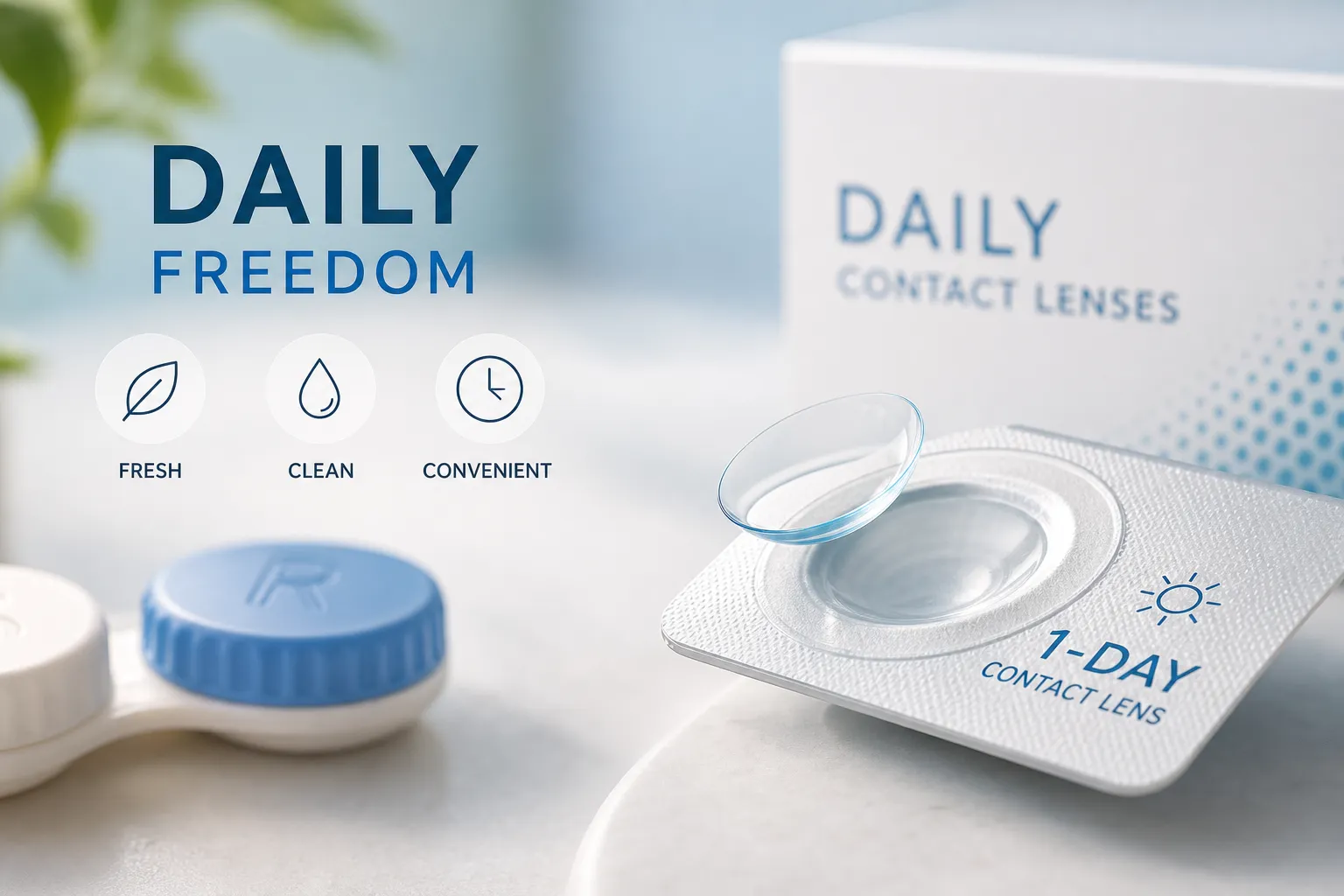
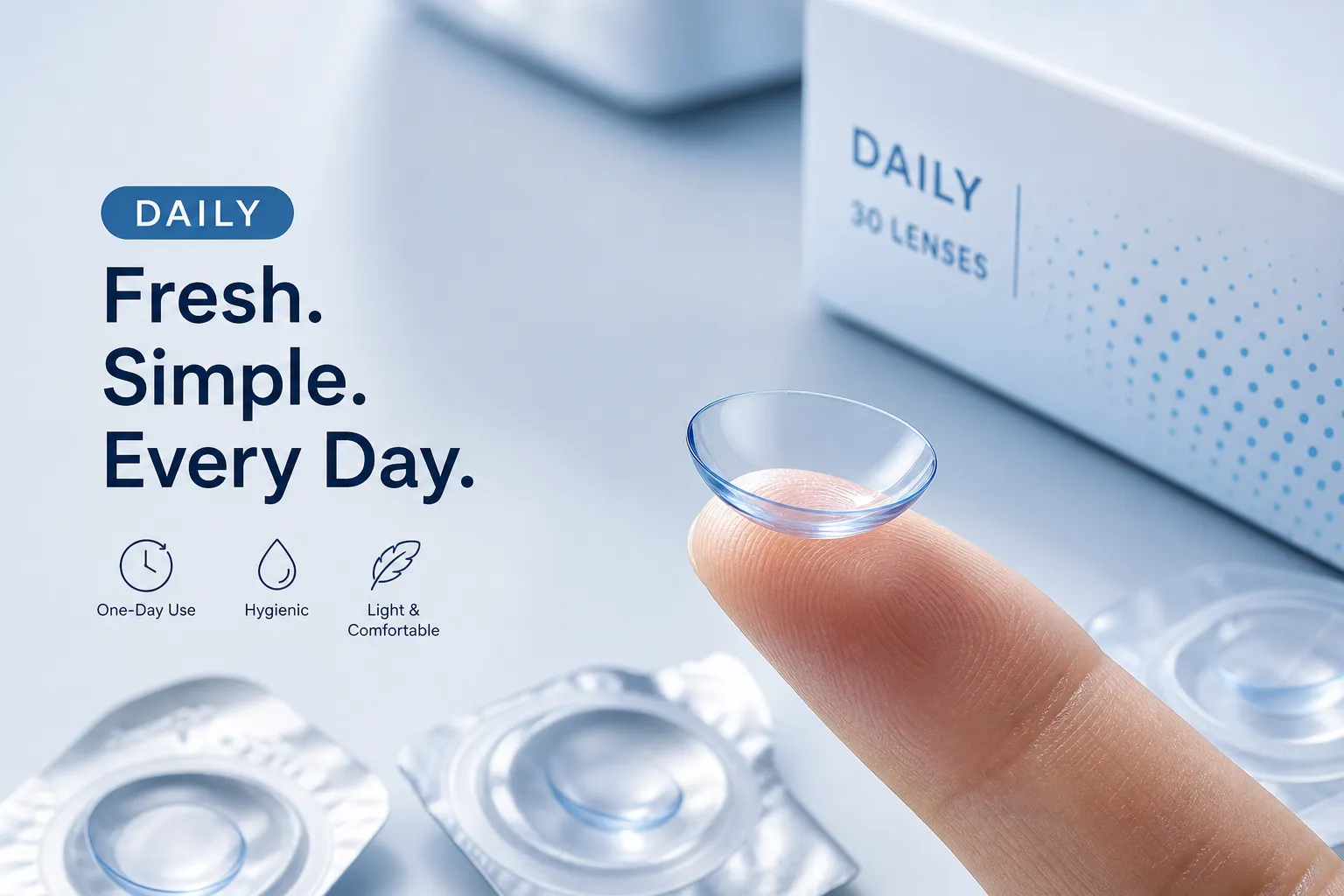
Daily disposables make compliance structurally simple. Each morning, a new lens is opened from its sealed blister pack. Each evening, it is thrown away. There is no case to contaminate, no solution to top off incorrectly, and no temptation to stretch the lens one more week because a new box has not yet arrived.
How silicone hydrogel helps
For wearers considering the lens material itself, silicone hydrogel daily disposables represent a meaningful upgrade over traditional hydrogel options. Silicone hydrogel lenses transmit significantly more oxygen to the cornea. While Dk/t values vary by product, silicone hydrogel materials can reach transmissibility levels well above those of traditional hydrogel lenses, which typically fall in the 20 to 40 Dk/t range, with some silicone hydrogel designs achieving values in the region of 100 Dk/t or higher. Traditional hydrogels rely on water content to carry oxygen, and as the lens dries throughout the day, that oxygen supply decreases. Silicone hydrogel lenses use a different molecular structure, maintaining more consistent oxygen flow through a full day of wear. For corneal health over time, this distinction matters.
The honest cost conversation
Daily disposable lenses cost more annually than monthly alternatives. This is worth addressing honestly. In South Africa, daily disposables typically run between R13,000 and R22,000 per year (estimated, depending on prescription complexity and brand). Monthly lenses, including cleaning solutions and replacement cases, generally land between R7,000 and R13,000 annually. The gap is real.
The comparison shifts meaningfully, however, when you account for what monthly lens ownership actually involves: regular solution purchases, replacement cases, and the follow-up consultations that often follow complications. Many clinicians consider preventing a single serious corneal event to outweigh the annual cost difference, and there is health-economic reasoning to support that view. For high-compliance wearers with healthy eyes and no history of irritation or allergic reactions, monthly lenses remain a clinically sound choice. But for allergy sufferers, irregular wearers, anyone with a history of lens-related red eye, or those who find the cleaning routine easy to let slide, the daily contacts benefits tip the balance firmly in favour of single-use lenses.
Daily vs monthly contact lenses: making the right choice for your eyes
The health benefits of daily contact lenses are not theoretical. They are grounded in consistent clinical evidence and endorsed by leading optometric bodies, including the BCLA, the College of Optometrists, and, in guidance on contact lens hygiene, the CDC. Whether they are the right choice for your eyes, however, depends on your individual eye health, wearing habits, lifestyle, and budget. That determination should happen in a proper consultation, not based on whatever was cheapest on a retail website.
When weighing up daily vs monthly contact lenses, there is no single answer that applies to everyone, which is precisely why a professional fitting matters. At EyeQ Optometrists, our full-service contact lens fitting process is designed for exactly this conversation. Across four Cape Town locations, Canal Walk, Cavendish Square, Tygervalley, and the V&A Waterfront, our practitioners assess not just your prescription but your ocular surface health, your lifestyle, and your wearing patterns to determine whether daily lenses are genuinely the healthier option for you. If they are, we fit them properly and source from a comprehensive range of leading global brands, including Alcon Dailies that many patients find comfortable.
Ready to find out whether daily disposables are right for you? Book an eye examination and contact lens consultation with EyeQ Optometrists. Your eyes deserve a decision made on evidence, not assumption. New wearers may also find our Top Tips for New Contact Lens Wearers | EyeQ a helpful introduction to comfortable, safe lens use.
Frequently asked questions about daily contact lenses
What are the main health benefits of daily contact lenses?
Daily contact lenses eliminate the lens case, one of the primary sources of bacterial contamination in reusable lens wear. They also remove the need for cleaning solutions (which can irritate sensitive eyes), enforce consistent replacement compliance, and reduce the risk of corneal infiltrative events and allergy-related lens complications.
Daily vs monthly contact lenses, which is healthier?
For most clinical risk factors, infection, allergy, GPC, and compliance failure, daily disposables carry a lower risk profile. Monthly lenses remain appropriate for healthy, high-compliance wearers. Your optometrist is best placed to assess which modality suits your specific ocular health and lifestyle.
Are silicone hydrogel daily disposables worth it?
For wearers who spend long hours in lenses or who have experienced end-of-day dryness, silicone hydrogel daily disposables offer higher oxygen transmissibility than traditional hydrogel options. This supports corneal health over extended wear and is worth discussing at your fitting appointment.
Can I get daily contact lenses fitted at EyeQ Optometrists?
Yes. EyeQ Optometrists offers full contact lens fitting consultations at all four Cape Town locations: Canal Walk, Cavendish Square, Tygervalley, and the V&A Waterfront. Our practitioners will assess your suitability for daily disposables and recommend the most appropriate lens for your eyes.