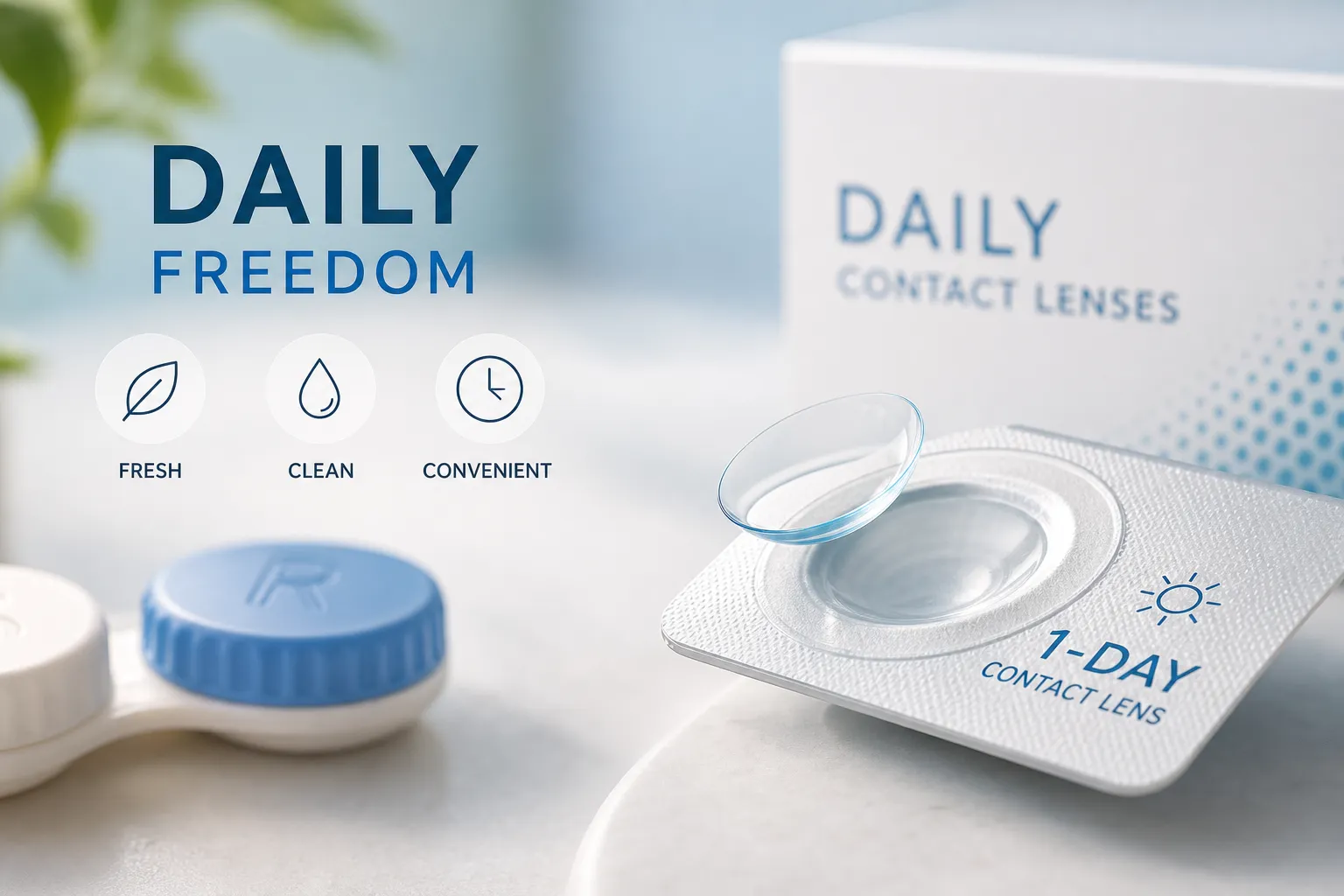
Most people spend more time choosing a phone case than choosing daily contact lenses, the devices that sit directly on their cornea for twelve hours a day. It can feel that way, at least. The phone case protects a device; the lens on your eye interacts with your tear film, your oxygen supply, and the entire surface biology of one of your most irreplaceable organs. The choice deserves at least as much deliberation.
Daily disposable contact lenses have changed what that decision looks like. The category has expanded well beyond a one-size solution: toric designs now address astigmatism, multifocal options manage presbyopia, and silicone hydrogel materials serve wearers with higher oxygen demands. Good optometry practice starts with the same two questions regardless of which lens ends up on your eye: what does your eye actually need, and which lens design will serve it best? This article works through those questions, covering how single-use lenses function, who they suit, what they cost in South Africa, and how to order them correctly once you have a valid prescription.
How daily disposables actually work
The single-use principle and why it changes everything
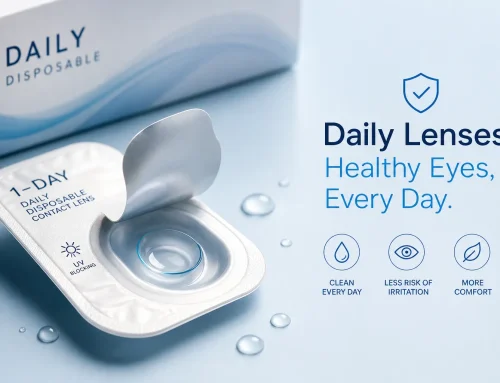
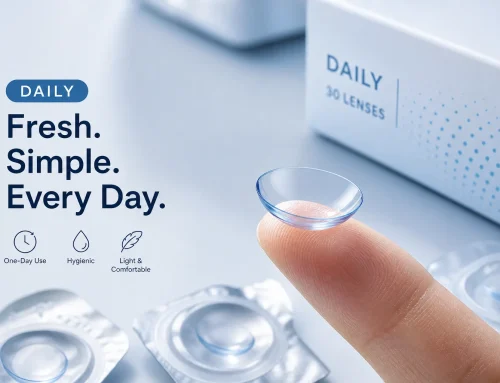
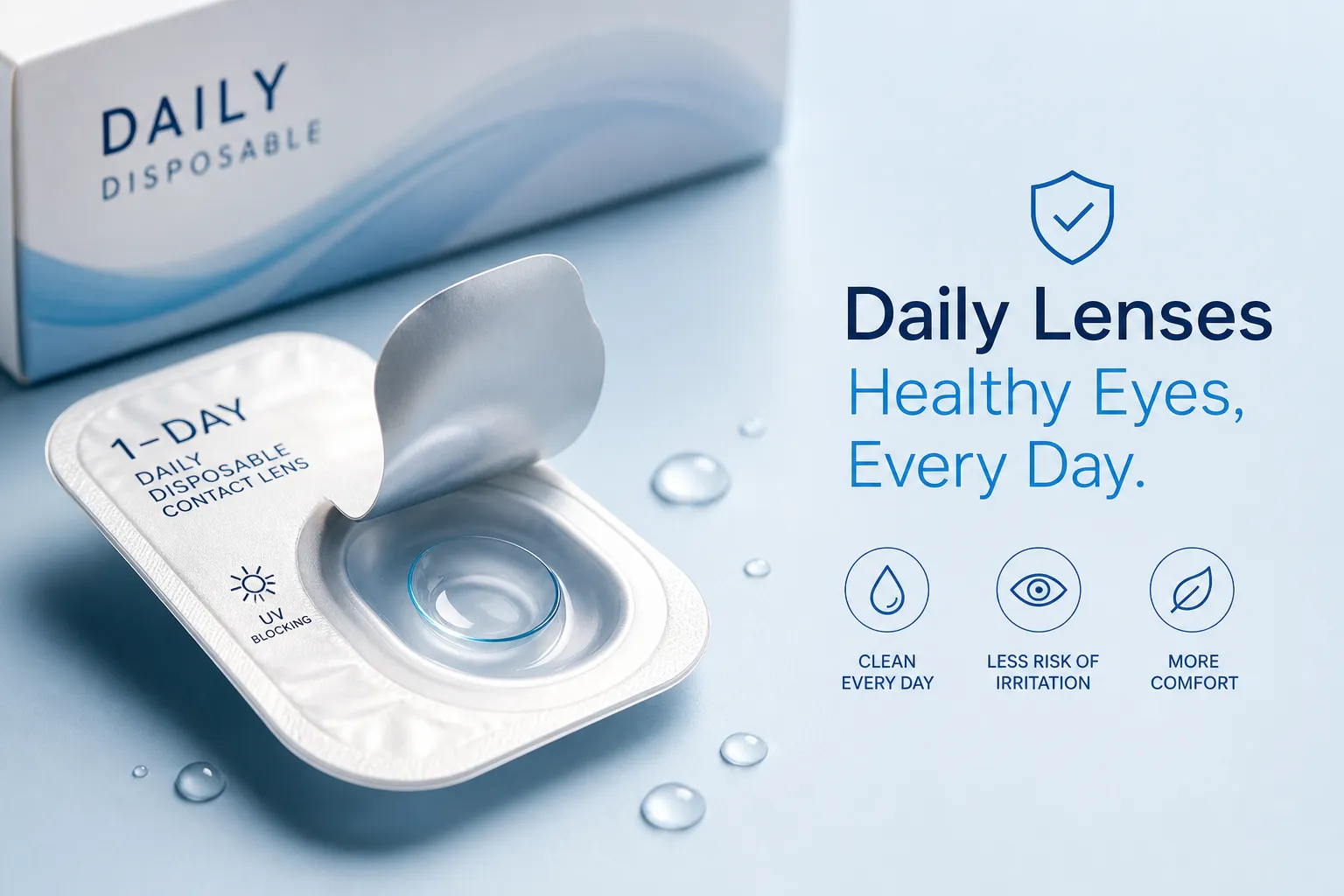
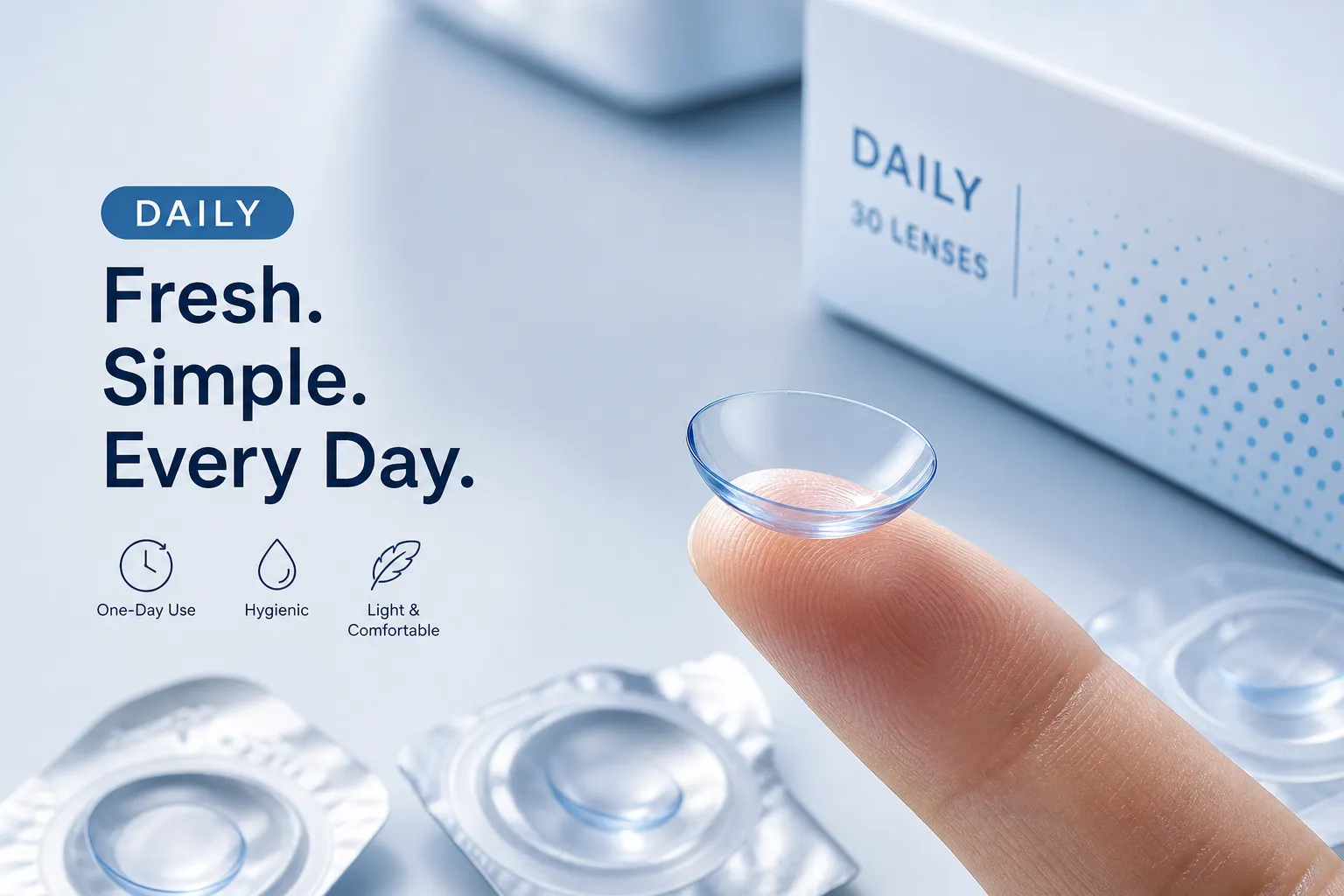
A daily disposable contact lens is manufactured, packaged in sterile solution, worn once, and discarded. That sounds simple, but the implications are significant. Because the lens is never stored overnight, never dropped into a case, and never exposed to a cleaning solution cycle, the entire chain of contamination risk that plagues reusable lenses is removed from the equation. Protein deposits, allergens, and environmental debris have one wear cycle to accumulate rather than weeks.
This is not a minor distinction. With monthly lenses, the lens you wear on day twenty-eight is carrying the residue of every blink, every dusty environment, and every imperfect rinse that preceded it. A fresh daily lens starts sterile every morning, a fundamentally different experience for the eye’s surface biology.
Daily contact lenses vs monthly lenses: the eye-health case
Monthly lenses depend entirely on consistent cleaning and case hygiene, and most wearers are less disciplined about both than they realise. Clinical guidance consistently shows that severe corneal infections occur more frequently with monthly replacement lenses than with daily disposables, a pattern explained by accumulated handling errors, storage case contamination, and the slow degradation of lens hygiene over a month-long wear cycle.
Daily disposables do not eliminate infection risk entirely, but they meaningfully reduce it. For anyone planning to wear contact lenses long-term, that reduction in both frequency and severity of potential problems is worth taking seriously. If you need help choosing between lens materials, see our guide to understanding the differences between soft and hard contact lenses.
Who benefits most from daily contact lenses
Dry eyes, allergies, and sensitive corneas
If your eyes feel gritty or dry towards the end of the day, a daily disposable lens offers a structural advantage over any reusable alternative. As a monthly lens ages through its replacement cycle, its surface wettability degrades and deposit build-up increases. A fresh lens starts with a clean, hydrated surface every time. Wearers with dry eye commonly report noticeably improved comfort with daily disposables compared to lenses worn across multiple days.
Allergy sufferers benefit for a different but related reason. Pollen, pet dander, and environmental allergens bind to lens surfaces. With a single-use lens, that accumulation is capped at one day. There is also no exposure to multipurpose cleaning solutions, which are a common trigger for sensitivity reactions in people with reactive eyes.
Part-time wearers and active lifestyles
Daily disposables are particularly well-suited to people who don’t wear lenses every day. With a monthly lens, skipping days wastes your replacement schedule and creates storage hygiene questions. With a daily lens, you simply open a fresh blister pack when you need one and discard it afterwards. That flexibility suits gym mornings, weekend trail runs, and evenings where glasses feel inconvenient.
For sport specifically, the ability to discard the lens at the end of a session is a genuine practical advantage. There is no post-exercise handling of a stored lens, no case rattling around in a sweaty kit bag, and no question about whether salt water or dust has compromised the lens surface during outdoor activity.
Daily lens options for astigmatism and presbyopia
Toric daily disposables: correcting astigmatism without compromise
Many wearers with astigmatism assume they cannot benefit from single-use lenses, but toric daily disposables are widely available in South Africa and have been for some time. A toric lens corrects two different powers across different meridians of the eye and includes a stabilisation system to keep the lens correctly oriented on the cornea. The fitting process is more involved than for a standard spherical lens because even a small rotation can affect vision quality significantly.
Locally available options include 1-Day Acuvue Moist for Astigmatism (30-pack, R709) and Dailies AquaComfort Plus Toric, which uses nelfilcon A hydrogel material with a 69% water content and a Dk/t of 26. Both are stocked through major South African optical retailers and can be prescribed after a proper toric fitting assessment.
Multifocal dailies for presbyopia and reading fatigue
Presbyopia, the gradual difficulty focusing up close that typically begins in the mid-forties, is increasingly well addressed by multifocal daily disposable lenses. Available options in South Africa include Clariti 1 Day Multifocal (R639 for a 30-pack) and Dailies AquaComfort Plus Multifocal (R749 for a 30-pack). Some practices also offer Acuvue Oasys MAX 1-Day Multifocal, which uses senofilcon A silicone hydrogel material with a Dk/t of 147 for high oxygen transmission; confirm availability and replacement schedule directly with your optometrist. These specialty lenses require a different fitting protocol, and not every practice stocks the full range across both brands.
What daily contact lenses cost in South Africa
Standard spherical lenses: entry point to premium
For standard spherical daily disposables, South African retail pricing in 2026 ranges from around R449 for a 30-pack of Clariti 1 Day to R579 for a 30-pack of 1-Day Acuvue Moist. SofLens Daily sits at R459 for 30 lenses, making it one of the more accessible options on the market. Stepping up to a 90-pack reduces the per-lens cost meaningfully: Clariti’s 90-pack retails at R1,139, Acuvue’s at R1,409, and SofLens at R1,059. For full-time daily wearers, the 90-pack arithmetic is straightforward.
What specialty lenses add to the cost
Toric and multifocal daily lenses carry a premium over standard options, reflecting their more complex design and manufacturing. To give a sense of the range for 1-day contact lenses in South Africa: Acuvue Moist for Astigmatism runs R709 for 30 lenses, Acuvue Moist Multifocal at R769, and Clariti 1 Day Multifocal at R639. The right lens for your specific eye condition matters far more than selecting the cheapest option available. A toric lens that stabilises correctly will outperform a cheaper spherical lens worn with uncorrected astigmatism every single day. When comparing daily contacts prices in South Africa, factor in pack size, replacement frequency, and whether the lens is actually matched to your prescription, not just the per-box figure.
Getting started and ordering your lenses online
Why the fitting appointment matters more than the brand choice
Selecting a daily contact lens brand without a professional fitting is one of the most common and costliest mistakes wearers make. Lens diameter, base curve, and the precise parameters of a toric or multifocal design must be matched to both your eye’s anatomy and your optical prescription. A lens that fits poorly will cause discomfort, unstable vision, and in some cases corneal irritation that takes weeks to resolve. For practical instructions on safe handling, refer to our article on inserting and removing contact lenses.
EyeQ Optometrists offers professional contact lens fittings at its Cape Town locations, including Canal Walk, Cavendish Square, Tygervalley, and the V&A Waterfront. The optometrists there work across the full range of daily disposable options, from standard spherical lenses through to toric and multifocal designs, and typically run a trial period to confirm the fit before you commit to a larger pack size.
How online reordering works once you have a valid prescription
A contact lens prescription is a separate document from a spectacle prescription and includes your optical correction values alongside fit-specific details such as base curve, diameter, and the specific lens brand and material prescribed. South African online retailers require a valid contact lens prescription before processing any order, so your first purchase will always involve a fitting appointment with a registered optometrist.
Once you have a prescription, reordering is straightforward: select your brand and parameters, enter your prescription details, and place the order. Many South African online optical retailers advertise nationwide delivery; check the specific retailer for transit times and terms. EyeQ Optometrists provides an online reordering option for existing patients, making it easy to restock your daily lenses without visiting the practice each time.
So, are daily lenses the right choice for you?
The clearest candidates are wearers with dry eyes, allergies, part-time schedules, astigmatism, or presbyopia. But even for full-time wearers without those complications, the hygiene and convenience case for daily contact lenses is strong. Lens technology, replacement schedule, and fit parameters matter more than brand recognition, which is precisely why the fitting consultation is where the decision should start, not the retailer’s product listing.
If you’re ready to explore whether daily contact lenses suit you, book a contact lens fitting at EyeQ Optometrists. For existing patients already wearing daily lenses, the online ordering platform makes restocking simple. Your eyes are worth a decision made with the same care you’d give anything else you depend on every single day.