This article walks you through the stages of the eye examination, how often you should book and what to expect on the day.
Most people only schedule an eye test when their vision starts to blur or when their spectacles are damaged or lost. This is understandable, but misses the point of having regular eye tests – an eye exam is a very important health check, not just a vision correction appointment.
A thorough eye test not only determines if you need a stronger prescription, it also screens for a number of eye diseases, such as glaucoma, macular degeneration, diabetic retinopathy and hypertensive retinopathy, often before you notice a single symptom. This is especially valuable as many of these conditions causes irreversible damage long before vision changes are noticed.
At EyeQ Optometrists, advanced ocular imaging and diagnostic technology is used as part of a routine eye test at all four Cape Town practices.
What a comprehensive eye test actually covers
The difference between a vision screening and a full eye test
A basic vision screening, such as the one done when renewing a driver’s licence, tells you one thing: whether your eyesight is sharp enough to pass a particular threshold. A full eye examination evaluates the entire visual system and the health of the eye. These are fundamentally different exercises, and confusing them is how serious conditions go undetected for years.
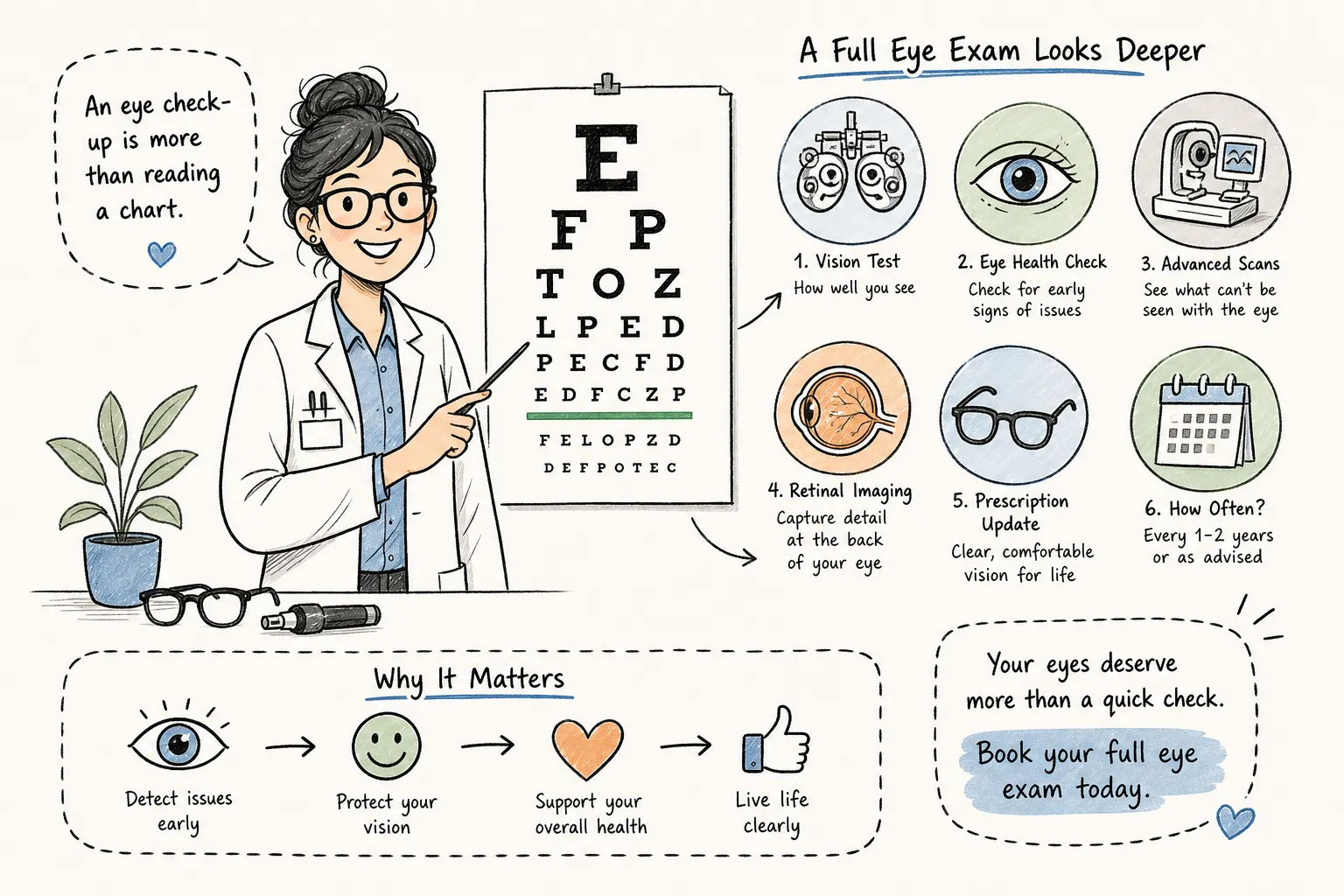
Visual acuity, the familiar eye chart test, is the starting point. From there, a proper eye test moves through refraction to determine your exact prescription, eye coordination and movement testing to identify binocular vision problems, corneal curvature measurement, intraocular pressure screening, and a detailed examination of the retina and optic nerve. Each test builds on the last to form a complete clinical picture.
A comprehensive eye test is more than just reading letters on an eye chart, testing for a new prescription and sending you on your way with new spectacles. It also entails checking eye coordination and movement, determining the corneal curvature measurement for contact lens patients, screening the intraocular pressure and an examination of the structures in both the front and back of the eye.
The full sequence of tests, explained clearly
The appointment begins with preliminary tests, including Tonometry, the “puff” test – measuring the intraocular pressure of each eye, which is a main way to check for glaucoma risk; Fundus photos and OCT scans – providing images of the retina to determine the health of the structures at the back of the eye; and Autorefraction – an indication of the prescription of each eye.
The next step is a patient history review. Your optometrist asks about current visual symptoms, any eye or systemic conditions such as diabetes, high blood pressure or cholesterol, current medication, family history of eye and systemic diseases, occupation and hobbies. The optometrist will discuss the results of the intraocular pressure test, as well as the retinal images and scans.
Refraction is next, the well known “which is better, one or two”, where a series of lens comparisons determines the precise prescription for distance and near vision. Keratometry measures the curvature of the cornea, and is done in certain contact lens appointments. A slitlamp is used to check the health of the front section of the eye, and to evaluate the fit of a contact lens. Additional tests that may be performed includes checking for cataracts, testing colour vision, depth perception, eye movements and pupil reaction.
How advanced diagnostics catch eye disease before symptoms appear
Why retinal imaging and OCT change the diagnostic picture
Retinal photography and optical coherence tomography (OCT) allow an optometrist to examine the retina and optic nerve in detail. OCT creates cross-sectional images of the retinal layers and optic nerve fibre, capturing structural changes that are invisible to any other method of examination. These baseline images are then compared at each subsequent visit to track changes over time.
What these images can reveal is clinically significant. Glaucoma can often be detected before any visual field loss is measurable. Macular degeneration appears as structural changes in the macula before central vision deteriorates. Diabetic retinopathy, retinal detachment, and the effects of high blood pressure on the retinal blood vessels are all identifiable at an early stage when treatment remains effective.
Eye pressure testing and the silent nature of glaucoma
Glaucoma is described as the silent thief of sight for good reason. It causes progressive damage to the optic nerve without pain or obvious vision disturbance, and without warning until a significant portion of peripheral vision has already been lost. Tonometry, which measures intraocular pressure, is a rapid test and one of the most critical components of any eye test.
Elevated eye pressure alone does not confirm glaucoma, and some people develop the condition with normal pressure readings. This is why the pressure test is interpreted alongside OCT and fundus scan results.
How EyeQ approaches the standard of care in Cape Town
The EyeQ services include eye examinations, eye health assessments, ocular imaging, myopia control, dry eye management, contact lens fittings, check-ups, spectacle repair and manufacture, and laser surgery assessments.
Using high-resolution imaging technology with our OCTS, capture detailed images & scans of the eye to establish a visual baseline, enabling one to monitor changes over time and detect early signs requiring further care. The EyeQ optometrists view this advanced imaging is integrated into their clinical assessments rather than treated as an optional extra.
The difference between an appointment that simply updates your prescription and one that actively supports your long-term vision lies in the equipment used, the time the optometrist spends with you, and the clinical depth of what gets examined. At EyeQ, the aim is a proactive health assessment, not merely a refractive confirmation.
How often you should book an eye check up
General frequency guidelines by age and condition
Many adults who do not wear spectacles have not had their eyes tested in many years, some will have an eye test every two years. It is very important to have a regular eye test even if spectacles are not required. Regular check ups will show any changes in vision, whether visual comfort, a deterioration in the clarity of vision or the onset of any disease.
The optometrist can advise what interval is appropriate for each individual patient. From 40 onwards, more frequent examinations are worth considering, because the risk of presbyopia, cataracts, glaucoma, and macular degeneration increases meaningfully with age.
If you already wear glasses or contact lenses, annual check-ups make practical sense regardless of age. Prescriptions shift gradually, and an outdated correction can cause eye strain, headaches, and reduced visual performance. Catching a change early prevents months of unnecessary discomfort.
Children and why they need exams before they can articulate a problem
Children do not know what normal vision looks like. If they have always seen the world slightly blurred, they have no frame of reference to flag the problem. This is why regular examinations are the only reliable way to detect paediatric vision problems. The first full eye assessment is recommended between ages 3 and 5, with regular check-ups thereafter as advised. School visual screening is a valuable tool to flag children who may need further testing.
Untreated vision problems in children do not just affect their eyesight. They directly affect reading ability, classroom performance, coordination, and developmental milestones. Amblyopia (lazy eye) and strabismus (eye turn) are both treatable when caught early and significantly harder to correct once the visual system matures.
Diabetes, high blood pressure, and the case for regular eye exams
For people with diabetes, an eye exam every year for both type 1 and type 2. Diabetic retinopathy is the leading cause of blindness in working-age adults, and it develops without warning. Annual screening is what stands between an early, manageable finding and irreversible vision loss.
Hypertension (high blood pressure) damages the small blood vessels throughout the body, including those in the retina, which leads to hypertensive retinopathy. Regular eye health checks are important to discover any changes as soon as possible, sometimes before a patient even realises there is the risk for vascular damage. An annual eye examination is valuable for anyone with hypertension.
Warning signs that mean you should not wait
Some symptoms require an urgent appointment with an ophthalmologist. Sudden vision loss, a dramatic increase in floaters, flashes of light, or a dark shadow moving across your visual field can all indicate retinal detachment, a surgical emergency. Severe eye pain accompanied by haloes around lights and nausea can signal acute angle-closure glaucoma. Sudden double vision warrants same-day evaluation.
If in doubt, contact your nearest EyeQ pratice for advice and/or an immediate referral to an ophthalmologist. If an emergency occurs after hours, it is important to attend the nearest hospital Emergency department for assistance.
Contact lens wearers should be particularly alert to eye pain or redness that persists after removing lenses. Bacterial and fungal infections can escalate rapidly and risk permanent corneal damage. If discomfort does not resolve immediately once the lenses are out, remove them, do not reinsert, and see an optometrist the same day.
What to expect on the day of your eye examination
How to prepare
A full eye test typically takes 30 min on average, depending on the scope of testing and whether specialised assessments such as contact lens fitting are included. Block the full slot and avoid scheduling anything immediately afterwards to allow ample time to choose new eyewear. Bring your current glasses or contact lenses, a list of any medications you are taking and your previous prescription if you have one. Also measure and record the distance from your eyes to the laptop or desktop screen you use for work or leisure, or for any specific hobbies you have that need crisp vision at a distance different from the usual 40cm.
The bottom line on eye health checks
An eye examination is not a formality you schedule when things start going wrong. It is a proactive health decision that can identify glaucoma, diabetic retinopathy, macular degeneration, and other preclinical conditions at a stage when they are still manageable. The logic is straightforward: the conditions responsible for the most significant vision loss are precisely those that progress without symptoms. A regular eye test remains the only reliable way to find them in time.
If you are in Cape Town and want a full eye check up that goes beyond reading a chart, EyeQ Optometrists offers the clinical depth and diagnostic technology to make every appointment count. Book online or visit their practices at Canal Walk, Cavendish Square, Tygervalley, or the V&A Waterfront.