Many people focus far more on frames than on lenses. That’s the wrong priority. The lenses are doing all the actual work. Frames are the container; lenses are the point.
Single-vision vs progressive lenses
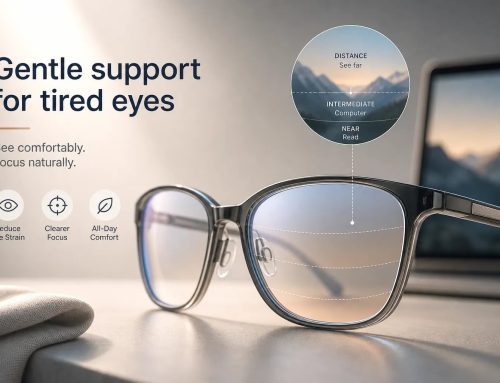
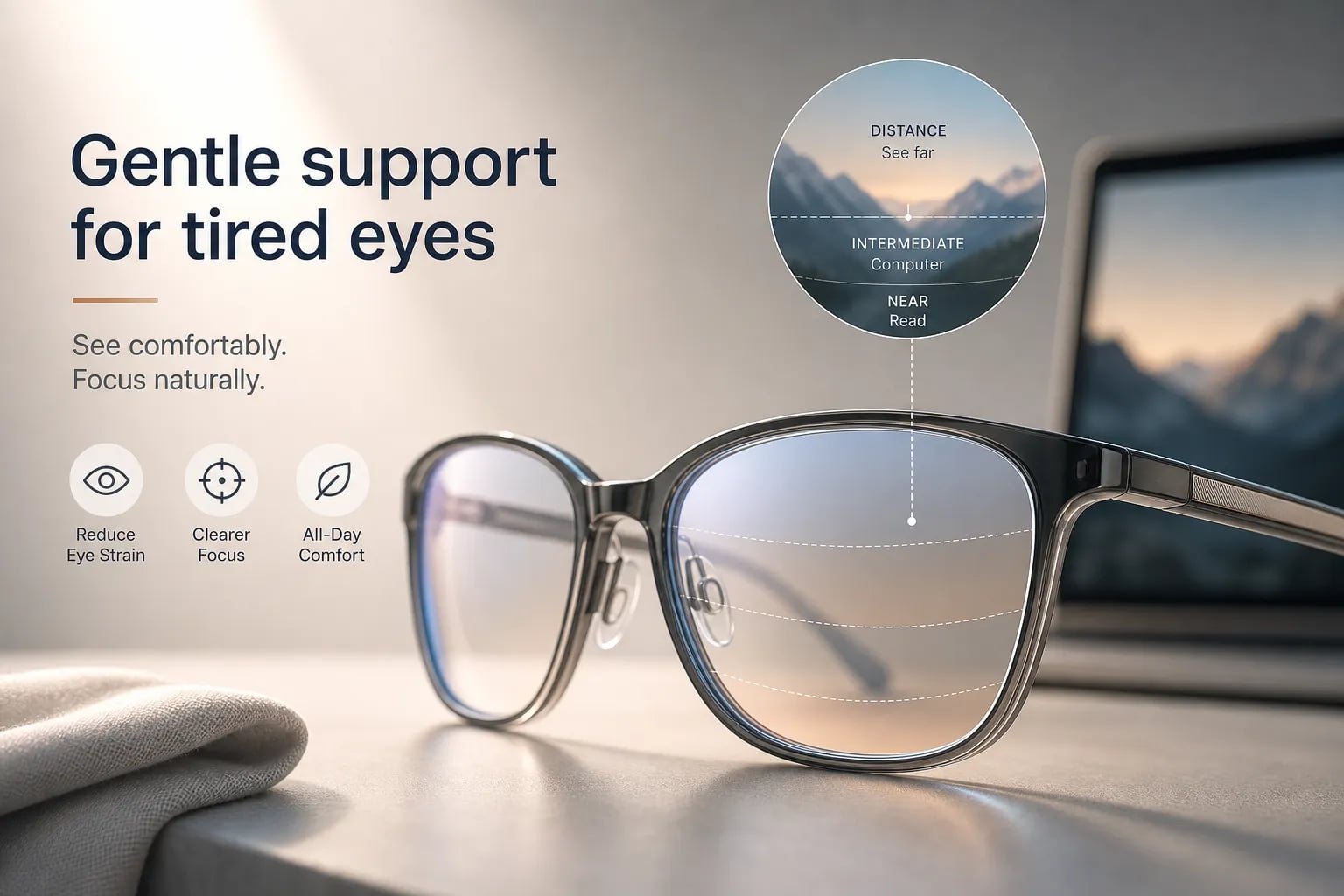
Single-vision lenses correct one distance, whether that’s near or far. They’re straightforward to adapt to, and for anyone who only needs help at one focal distance, they’re entirely the right choice. Progressive lenses, sometimes called multifocals or varifocals, handle near, intermediate, and far vision in a single lens with no visible dividing line. They’re genuinely versatile, but they do require an adjustment period: the wearer has to learn which part of the lens to look through for each distance. That adjustment is faster and smoother when the fitting is done properly. In South Africa, single-vision lenses typically range from R500 to R3,500 depending on the index and coatings; progressive lenses sit higher on that scale. Knowing this before you walk in gives you realistic expectations and prevents you from being surprised at the counter. For those who only need simple near correction, some people consider off-the-shelf reading glasses (ready made readers) as a short-term option, but they lack the personalised fitting and precise measurements of prescription lenses.
Coatings that genuinely improve daily wear
South Africa has a specific set of lifestyle conditions that should shape your coating choices. UV exposure here is intense and cumulative, which means lenses that block 100% of UVA and UVB aren’t optional; they’re essential. Anti-reflective coating reduces glare on screens and in bright sunlight, improving both comfort and visual clarity throughout the day. If you move frequently between indoor office environments and outdoor sun, photochromic lenses are worth considering, they darken automatically in UV light and return to clear indoors. Blue-light filtering is worth adding if extended screen use causes you noticeable discomfort, though its benefits are more about comfort than medical protection. Coatings work best as a needs-based decision, matched to your actual daily environment rather than accepted as a default bundle.
How face shape changes the way frames work for you
A frame that looks striking on the display stand can look entirely wrong on a particular face. This isn’t a matter of taste. It’s a matter of proportion. The right frame balances your features by contrasting with the natural lines of your face. The wrong one emphasises what you’d rather not.
Matching frame shapes to your facial features
Round and oval faces generally suit angular or rectangular frames, which add definition and create the appearance of length. Square faces benefit from rounder, softer silhouettes that ease strong jawlines and brow lines. Heart-shaped faces, wider at the forehead and narrower at the chin, balance best with frames that have wider bases and lighter upper sections. Oval faces are the most flexible, with most styles working well; the advice here is simply to try shapes you wouldn’t normally consider. Treat these as starting points, not rules. The goal is to find what you’d actually wear every day, ideally with a trained eye guiding the process rather than a mirror in a busy shop. If you want practical, step-by-step help, see our guide on how to choose glasses that suit your face.
Frame materials and long-term comfort
If you wear glasses for eight or ten hours a day, the material your frames are made from matters more than most people expect. Acetate offers rich colour and a style-driven aesthetic, but it carries more weight than metal alternatives. Pure titanium sits at about 9 to 12 grams, exceptionally light and durable enough to outlast heavier alternatives. Beta-titanium adds some flexibility to the mix, making frames easier to adjust and more forgiving if you’re hard on eyewear. Brands like Lindberg and Mykita are known for engineering these materials to address the comfort problem that heavier frames create. For daily wear, material choice is not an aesthetic detail; it’s a comfort decision.
Why the optometry practice matters as much as the glasses
The frame on your face is only as accurate as the prescription behind it, and only as comfortable as the fitting that followed it. A rushed eye test and a self-service frame rack are not an optometry experience. They’re a transaction. The distinction is worth understanding before you book anywhere, whether you’re searching for affordable prescription glasses or a premium designer frame.
What a thorough eye examination actually includes
A basic vision screening tells you whether your distance vision falls within a normal range. A comprehensive eye examination tells you far more. Modern diagnostic technology, retinal imaging, intraocular pressure measurement, binocular vision assessment, reveals the health of your eye structures, not just your visual acuity. Glaucoma, macular changes, and early signs of diabetic eye disease are all detectable during a thorough examination long before they affect your vision noticeably. A free or low-cost screening and a full optometric examination are simply not the same service. Knowing the difference means you won’t mistake one for the other, and it’s one of the most important things to check when comparing any eye test near me.
The fitting appointment most people skip
Expert dispensing is the step where a trained optician measures your pupillary distance, vertex distance, and frame alignment precisely against your prescription. For single-vision wearers, a poor fitting means chronic eyestrain. For progressive lens wearers, it means lenses that technically pass the prescription test but never quite work the way they should. The fitting appointment is not an afterthought; it’s where the prescription becomes functional eyewear. Any reputable South African optometrist will also require a valid, current written prescription before dispensing lenses, and most retailers treat a prescription older than 24 months as expired. If yours is approaching that mark, a new examination is due.
Finding prescription glasses near me that actually deliver
When you’re evaluating a local optometrist before booking, the checklist is straightforward: advanced diagnostic equipment, qualified optometrists (not just dispensing staff), a frame selection broad enough to serve different budgets and styles, transparent pricing, and a proper fitting process. Whether you need same-day glasses near me for a time-sensitive situation or a more considered consultation, the first place you find on a map may tick some of these boxes. It may not tick all of them.
EyeQ Optometrists ticks each of these items. With store locations across Cape Town’s major retail centres, including Canal Walk, Cavendish Square, Tygervalley, and the V&A Waterfront, access is genuinely convenient from most parts of the city. The practice pairs advanced ocular imaging with a curated designer eyewear collection that spans brands such as Lindberg, DITA, Oliver Peoples, Mykita, Cartier, and Gucci, alongside options across a range of price points, making it a strong choice whether you’re looking for affordable prescription glasses or investment-level eyewear. A single visit typically covers a comprehensive eye examination, lens consultation, frame selection, and precise fitting, though turnaround times may vary depending on prescription complexity and lens availability.